

Episode 30 – Dan Broihan from Automation Controls and Engineering – ACE
Joining Manufacturing Matters is Dan Broihan with Automation Controls & Engineering (ACE), who shares his thoughts on working with manufacturers new to automation, recruiting the next generation of workers, and growth opportunities outside the U.S. ACE, which provides turnkey automation and integration systems across a variety of applications, sees increasing demand within its company and its partners.
“If you don’t automate, you will evaporate,” Broihan says. In fact, those companies that invest in automation are seeing higher operational efficiency, throughput, and quality. One of the biggest industry challenges is attracting younger workers, who “don’t want to do the dull, dirty, dangerous work” affiliated with the traditional factory floor, he says. Instead, they want high-tech jobs — a perfect fit for today’s increased need for automation. Broihan also discusses ACE’s expansion into Mexico

Winn Hardin: [00:00:07] Hey, everybody. Welcome to Manufacturing Matters, a new episode where we cover the manufacturing technology that’s important to you. We’re broadcasting live from Detroit, where A3 is hosting the Automate conference here at one of the biggest expos in North America related to automation, robotics, machine vision, artificial intelligence, and all the technologies that go into making automation so important. I’m here with Dan Broihan with ACE, Automation Controls and Engineering. Dan, tell me a little bit, first of all, how’s the show been? How’s the week been?
Dan Broihan: [00:00:35] Show has been really, really good. We see a lot of traffic this year, a lot of people coming out that are brand new to automation. So it’s been really phenomenal.
Winn Hardin: [00:00:44] That’s good because lord knows we need a whole lot more people in this industry. I know the career center in the back has been an important part, so hopefully, and I’ve seen a lot of kids going around this year, not just your college types but high schools, younger kids. That’s nice. I bet you probably got a few open spots right now over at ACE.
Dan Broihan: [00:01:01] We’re always looking for good people. In fact, we’re expanding. So yeah, we’re going to be moving shortly. We’ve been moving from Dexter to Howell.
Winn Hardin: [00:01:08] A much bigger building?
Dan Broihan: [00:01:10] Yeah, absolutely. Three times the size. We’re going from 30,000 square feet to a 100,000 square foot building, which will give us about a quarter million square feet under roof.
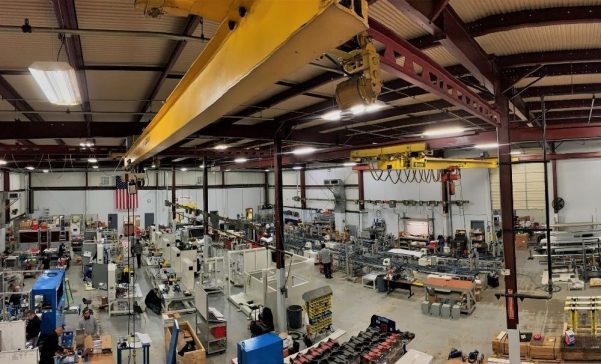
Winn Hardin: [00:01:19] Wow. All right. So I know ACE as one of the lead integrators in the business, but tell us a little bit more if you could.
Dan Broihan: [00:01:25] Yeah, well, we do general assembly, but we specialize in assembly systems, material handling, machine load. We’ve been really fortunate with the fact we have a lot of customers out there that are looking for manual load replacements So there’s CNC companies out there that are looking for operators. They want to buy a machine. Doesn’t make any sense because they don’t have operators. We’ve got some standard products that we can put in front of the machine that actually automatically loads the systems in and also unloads. We can do inspection and everything else.
Winn Hardin: [00:01:58] So a lot of machine tending primarily in metal or you also do some flexion, plastic injection?
Dan Broihan: [00:02:03] We do it all, basically, anything that needs to be loaded and unloaded, if it can be done with a human hand, we can do it robotically.
Winn Hardin: [00:02:09] Primarily at the work cell level or also doing some line building?
Dan Broihan: [00:02:12] We’ll do line building as well. So yeah, work cell, line building. We used to specialize really in the work cell, but lately we’ve been getting into the larger lines. We focused on half a million to million dollar systems. Now we’re really focused on the $5 million to $10 million jobs.
Winn Hardin: [00:02:27] Beautiful. So I want to start with the high-level discussion about what trends we’re seeing. One of my favorite things about speaking with integrators and line builders is that you guys are a nexus. All the different technologies, you bring them all together. You tend to be agnostic, right? So you’ve got a real good idea about who’s hot, who’s really performing well, and at the same time you’ve got your finger on the pulse of the industries that have the highest demand right now. So lay out for us a couple of the key trends that you’re seeing.
Dan Broihan: [00:02:51] The big trends we’re seeing right now are companies that have never automated before. So we’re talking about the typical manual operations. We’ve had air conditioning companies coming in. We’ve had pool heater companies coming in. Where typically your workforce is in their 30s and 40s, well now they’re 50, 60s and they’re retiring and they’re not being replaced. So now they’ve got to automate and they’re coming in and recognizing the fact that if they don’t automate, they’re going to evaporate. FANUC is a good partner of ours. Rick Schneider, the former president, said that you either innovate or you evaporate. I’m saying you automate or evaporate. Right now I’ll say if you’re not automating, you’re going to be out of business in five or 10 years, easy, because you won’t have a workforce, or the workforce is going to be so expensive that you’re not going to be able to produce your product.
Winn Hardin: [00:03:40] Now a lot of people point to COVID in terms of labor shortages, but we all know about the great retirement, right? So it seems like it’s a double whammy. It wasn’t just that we all had to go into a different way of business and kind of slow down for a couple of years. But at the same time, a lot of folks who were the baby boomers decided, you know, this is a good time to expel, you know. So I think what I’m hearing from you is that this trend is not going to snap back. It’s not like it’s going to suddenly slow down. We can expect as the baby boomers continue to retire, those folks in their 50s and even 60s, who are by the way taking a whole heck of a lot of knowledge with them about operations, and how automation can help level that playing field a little bit. So that trend in terms of labor shortages and workforce isn’t going away anytime soon.
Dan Broihan: [00:04:26] No. In fact, I think it’s getting worse, because manufacturing is increasing, but if you don’t have a labor force, you can’t increase your manufacturing. The demand is there, so now we need automation, we need systems, we need some innovation coming. And the other trend is nobody wants to do those dirty, dingy, dangerous jobs anymore. The mundane stuff. People want tech, people want excitement. They’re coming to work to do something to make a difference. And that’s what the new generations are looking for. Well, in the automation group, we can offer that to them. It’s all high tech now. We’re getting into AI, we’re getting into a lot of different vision systems. We’re getting into robotics. We are one of the leaders in the FANUC robot line where we’re selling for our size company, the number of robots we’re selling every year is just increasing. We’re probably doubling what we did last year, and we’re probably going to double that again next year.
Winn Hardin: [00:05:16] You know, it is just really actually not just good for, in terms of automation what it delivers to your companies and the manufacturing industry at large. But the people who do remain, the new generations who are coming up, these folks want to get paid. So automation gives them a path towards increasing their skill set, from the standard machine operator, CNC operator, lathe operator, something like that, to now monitoring multiple machines. Figuring out how to troubleshoot and integrate new routines, handle changeover easier, faster, better. And the flexible automation is helping to make that possible.
Dan Broihan: [00:05:49] Absolutely. Lights out is coming. We’re hearing more and more companies saying they want to minimize the number of people on the line, if not eliminate them. And it’s not a matter of eliminating jobs. And we know this. A3 has proven it many, many times, that when you put robots into your factory, you actually increase your productivity, you increase your throughput, you decrease your costs, and you can grow and you hire more people. So your net gain is positive.
Winn Hardin: [00:06:16] Exactly. Yes. The workforce actually expands as a result of automation. It’s completely a fallacy that somehow the robots are coming in and replacing workers, because any company who’s really adopting this technology wholeheartedly is growing at a rate that it’s creating far more jobs than it’s displacing. And making better jobs while we’re at it. So that’s cool.
Dan Broihan: [00:06:34] And that’s key. So customer satisfaction is up. You get higher throughput. We talk about OEE, right? Yeah. The operating efficiency of a line. We’re taking it from sometimes 75%, 80% to 99% – 97% on average. And companies that are looking at this are saying, why wouldn’t I automate? They’re getting better throughput, they’re getting better quality. They don’t have to worry about people not showing up. You know, health care costs are going up all the time. And you’re paying a lot of money even for temporary workers today. We have a customer right now, they’re using office workers because they can’t find people. So you’re paying these office workers a tremendous amount of money to go out and do menial labor jobs that take no education. It’s a start-up job. And they’re forcing these people to do that if they want to keep their jobs. And they’re losing people.
Winn Hardin: [00:07:23] Exactly. That’s an unhappy workforce, especially when you’re down to 3% or lower in unemployment, I mean, especially in North America. But that’s also one of the nifty things about ACE, if I understand correctly. You guys don’t just work here in the United States, not even just North America – Canada and the U.S. So we were talking briefly earlier about some interesting trends you’re seeing in Central America. Can you share that with our folks?
Dan Broihan: [00:07:43] We’re starting to see a lot more traffic from Mexican corporations looking for U.S. automation companies. They have very few good automation companies in Mexico. So they’re coming here. They are having labor problems also and also the quality issues. So they’re taking advantage of our know-how, our technology, having lines built up here and then shipped down there. Fortunately with ACE, we’ve got partners down in Mexico where we basically bring the partners up during the final weeks of the integration and then use those guys for the installation and support later on. So we get a win-win. We don’t have to have this tremendous cost to do the installation because we don’t have people living down in Mexico for weeks on end to get the system up and running.
Winn Hardin: [00:08:23] Plus you’ve got trained folks who can go down there and train more operators, so you’re helping to scale both the human component as well as the technical benefits.
Dan Broihan: [00:08:33] And training is key. When you take a labor force that’s not used to automation, you’ve got to find some good people that know what they’re doing in controls, convert those into robot programmers and PLC programmers and things like that so that they can support the line when it goes down. The customers that go forward and really educate their labor force are the ones that are successful all the time. The ones that don’t embrace the technology and don’t train their own people, they’ll fail.

Winn Hardin: [00:09:00] Well, they’re not going to innovate, that’s for sure. Wouldn’t it be so cool, I mean, at some future point, you’ve got to think that some of these other Central American and even South American countries, once they can stabilize a little bit, there’s been so much turmoil down there. But I mean, think about the market demand. I mean, we were all talking about Brazil a lot, you know, 10 years ago in terms of being the next great market. Are you guys playing down there in South America right now?
Dan Broihan: [00:09:25] We have. Unfortunately, there’s a lot of taxes that are involved. So import taxes and whatnot. There’s a lot of restrictions. So we pulled away. We were working with Ford, and now Ford is no longer in Brazil. So that was one of the areas that we played. Case in point. Now we’re looking at our partners of Mexico. I mean, they’re a little closer. They know our North American trends, our U.S. trends and what we do, and they’re familiar with us, so it works out well.
Winn Hardin: [00:09:51] Awesome. So ACE is moving to a new facility. You guys are obviously making a lot of changes. I mean, the last couple of years have been gangbusters for you, if I’m not mistaken. Performing even above the curve, and the curve has been pretty high.
Dan Broihan: [00:10:04] Curve’s been pretty high. COVID, we were very busy. We did a lot of mask machines for obvious reasons. But we actually delivered a system that was typically a 40-week system. We got that delivered in eight and a half weeks. You couldn’t do it today because of the supply chain issues, but back then, we basically told the company that we did the work for, if we can use our specs, use equipment that’s on hand or readily available, we can build you the system. We designed and built the system on time and actually shipped it a half week early.
Winn Hardin: [00:10:37] So it’s interesting. I think tomorrow I’m going to be talking with Alex Shikany and the new guy, Robert McMurray, who are business intelligence folks here at A3. So we’re going to hear some more about trends and markets. But supply chain is still an issue.
Dan Broihan: [00:10:53] It’s getting better, but yes, it’s still an issue. And I don’t think we’re going to fully recover because, again, they have labor shortages as well. So even the logistics part of it, Fedex and UPS, they can’t find drivers. They have to charge more because they’re paying their people more because they’re working more overtime. It’s a snowball effect. So people don’t believe in trickle-down, I would tell them to go through a recession one time.
Winn Hardin: [00:11:17] What about the microchip situation specifically?
Dan Broihan: [00:11:19] We’re not hearing a whole lot right now. We know that the automotive is affected by it, but we’re affected by it a little bit through PLCs and other different components. But I think what I heard is the automotive doesn’t pay enough, so they don’t get the primary contracts. The entertainment industry does. So people like Xbox and whatnot will get the first dibs. But then you have the automation controls issues and vision systems and whatnot. So they probably pay a premium for their chips. So we don’t see it too much.
Winn Hardin: [00:11:46] Well, as long as you’ve got enough supply to keep the world turning. So I guess right now, right. Can you give us some insight to where we’re at in lead times? You talked about the ability to do a 40-week in an eight-week time frame, which of course is amazing and not going to happen every time, that’s for sure. But what are we looking at right now? And I know you’re getting into bigger and bigger lines, too. So it’s kind of like a multi-pronged question.
Dan Broihan: [00:12:09] Depending on the level of complexity and design and everything else, we can get systems out in about 25 to 30 weeks. Smaller systems. The bigger systems we were quoting at 38 to 40. We’re now at 40 to 42, depending on components. And we also are very up front with our customers, letting them know that if we have problems, we identify the long lead items right up front. And we give them the list and we ask our customers, especially the larger OEMs, if they can help us. And if they can’t, then they understand that they’ve done everything they could. We’ve done everything we could to deliver the system. We’re going to do everything we can.
Winn Hardin: [00:12:42] So the shadow of the pending recession hasn’t really hit, at least ACE.
Dan Broihan: [00:12:46] We’ve seen the different economists talking, and they’re saying, yes, there may be a general recession for the retail environment, but automation, because of that force multiplier, we are looking at actually growing during what could be a recessionary period.
Winn Hardin: [00:13:05] Won’t be the first time that’s happened. My last two decades of being in the automation industry. It’s been pretty much recession-proof for the most part. I mean, I don’t remember the last time we took a dip. We might flatline for six months, you know, but generally it’s been just positive growth for literally probably going on 15, 20 years.
Dan Broihan: [00:13:23] I agree. I agree. And the multiplier, there’s a multiplicative effect right now with the fact that we don’t have the labor. We don’t have actually willing participants to be in this business right now. As far as the the manual labor business, there’s kids nowadays, everybody’s going to college. They don’t want to come out and make $15 an hour. You’re making $16 an hour at McDonald’s. So they’re coming out, they’re expecting a $40,000 $50,000, $60,000 paycheck. You’re not going to do that putting screws in on a line.
Winn Hardin: [00:13:55] Right or even welding. I mean, there’s just such a dearth of welders that’s coming up. I heard someone the other day say there are 200,000 unfilled welding positions. That’s obviously a huge market opportunity because we see a lot of robotic welding. We always have. But now we’re getting much more advanced, including light, industrial, cobots, and their flexibility.
Dan Broihan: [00:14:17] And the reshoring is still going on from China. So a lot of the products that were built in China, especially the more complex products, they’re coming back here, and companies are saying we need automation because they don’t have enough people to fill those positions. There’s a sporting goods manufacturer. They make football helmets. They basically are trying to start up a company down south. They need 300 employees. They did a call through even the news, the local news. They got 100. That’s it.
Winn Hardin: [00:14:50] And that’s south U.S. we’re talking.
Dan Broihan: [00:14:52] Southern U.S. I won’t give the name right now. We’re still working with them. But there’s a great opportunity for them to put robots and start out fresh in making these high-end helmets with robots.
Winn Hardin: [00:15:06] All right, Dan, so we’re coming close to an end here. So if I could, and I can’t think of a better environment to ask this question, but you mentioned AI earlier in terms of something that might be integrated. So I wanted to ask you, what are you most excited about that you’re seeing on the show floor? But I would love to get an integrator’s perspective about AI’s true capability and how it’s being deployed right now. So maybe that fits into your answer. Maybe it doesn’t.
Dan Broihan: [00:15:27] It does. AI is still early. I talked to several people that were coming over and they were talking to us as an integrator about AI and especially in vision systems. I’ve been in the vision world for a long time. Deep learning has been a buzzword for the last 10, 5-10 years. It’s now coming to reality because I think the computing power is there. Also, the algorithms are getting better. The only thing that we have to always watch out for is what is the need for AI? When do you overuse that system? When do you really need it? Also, everybody has to understand there is a cost to implementing the AI because you have to teach the system the basics first before it can start learning. Then there’s a lot of repetitive defect identifications and things like that in the vision systems. We were just talking, you mentioned welding, there’s a company out here, I know one of the gentleman that’s working there, software engineer. They’re using AI to create weld paths. So intuitively going in, you don’t have to be a precision welder because we do have the welding shortage. Just touch off some points, give it the weld parameters, and then let it go, and you may have to run it a few times, when it learns by being corrected every single time. So the AI is the future. It’s still early. We’re not talking about “I Robot” yet, hopefully, but I think that it will be the end game for the automation world.
Winn Hardin: [00:16:53] And I think there’s finally a recognition. I think there’s always been amongst the insiders, but most of these solutions today are hybrid solutions. You’re going to be using traditional systems just like we’re still using traditional fixtures, even with our robotics solutions in many cases. It’s just more efficient. But the same thing in machine vision can be said too. Traditional rules-based machine vision is along with deep learning. That’s usually going to be the best solution, if DL has anything to offer at all.
Dan Broihan: [00:17:19] Absolutely. I totally agree. Like I said, it is the future. We’re learning. I think everything is being evaluated right now. I remember when robotics first started, everybody used way too many robots. They over-automated and they lost money. I have a feeling the same thing is going to happen with the new bandwagon that everybody is jumping on with AI. It’ll settle down and then it’ll become real.
Winn Hardin: [00:17:42] Yeah, I know a lot of people got burned. Probably four or five years ago, I would talk with integrators and they’d be like, you know, they were more interested in trying to build a work cell that they could kind of multiply and sell that over and over, especially for smaller integrators, not anyone as big as ACE, but they got burned hard by AI. So there was some real reticence to get back into that bandwagon. But as you walk around the show floor now and you see companies like Beckhoff and others that are actually including AI into some of their, like the XPlanar system, in terms of just mapping out levitating systems for adaptive manufacturing. When the industry starts eating its own cooking, then you know something’s really going to have an impact. And that’s what I’m really seeing most impressed this year. Dan, I can’t thank you enough for taking a couple of minutes out of your day. I know you’ve probably got another 50 customers lined up waiting for you over at the booth.
Dan Broihan: [00:18:37] It’s been busy, that’s for sure. That’s good.
Winn Hardin: [00:18:39] Thanks for coming. I always love seeing you. All right. So until our next episode of Manufacturing Matters, please be sure to like us. Enjoy our episodes on your favorite podcast platform. You can catch our older episodes at manufacturing-matters.com. If you want to be on the show, feel free to reach out that way. And until next time, remember that in the U.S. and around the world, manufacturing still matters.