Episode 66 – Randall Hinton, Business Development Manager, Edmund Optics

In this episode of Manufacturing Matters, TECH B2B Marketing’s Jimmy Carroll and John Lewis speak with Randall Hinton, Business Development Manager at Edmund Optics to learn more about the evolution of laser integration with machine vision systems and the challenges that come along with it, like focus, laser damage threshold, rapidly evolving machine vision technologies, and more. They cover some of the latest trends and applications in lasers and optics, including growth in high-precision applications that need real-time monitoring of machining processes, like pharmaceutical and medical device applications, and highlight how Edmund Optics is enabling the success of these installations.
Edmund Optics Logo

Episode 66 – Randall Hinton, Business Development Manager, Edmund Optics PG.mp4: Audio automatically transcribed by Sonix

Episode 66 – Randall Hinton, Business Development Manager, Edmund Optics PG.mp4: this mp4 audio file was automatically transcribed by Sonix with the best speech-to-text algorithms. This transcript may contain errors.

Jimmy Carroll:
Hi everybody. My name is Jimmy Carroll. I’m the vice president of operations at Tech B2B Marketing. We are here at SPIE Photonics West 2024 doing the Manufacturing Matters podcast. And I have the pleasure of being joined by Randall Hinton and John Lewis. Randall is from Edmund Optics, and I guess, Randall, for those out there who don’t know Edmund, which I don’t think there are too many people, at least beyond the industrial space, they might not know, but people here and in automation and photonics, they know Edmund. But if you could still give us a background on the company, what you do there, and what you guys are excited about, that’d be great.

Randall Hinton:
Sure, so honored to be here. Thanks, Jimmy, John. Yeah. So Edmund Optics.we’ve been around since 1942, and the catalog has been a big part of that business. But what you may not know is half of what we do is custom. We have eight manufacturing sites worldwide manufacturing components, lenses, prisms, doing custom laser optics. We just kind of integrated a new factory down in Florida, expanded. And so we’re doing a lot of laser coatings there and high laser damage threshold coatings, whether that’s in defense or in laser cavities in medical devices, and, yeah, it’s been an exciting time.

Jimmy Carroll:
Yeah. I wanted to ask about that new facility because that’s relatively new, right? So beyond the obvious, what are some ways that that’s helped you respond quicker to customer demands or get out ahead of them?

Randall Hinton:
Yeah, well, it’s really opened new markets. So I’ve been really focused on the last couple of years kind of looking at laser integration, so that’s really enabled us to do more high laser coatings, dichroics, going after the laser cavities of medical devices. We’ve also started doing laser crystal polishing there and really kind of shoring up some of the defense business in that realm. So it’s really broadened our portfolio and allowed us to service kind of a different application range.

John Lewis:
Can you talk a little bit about some of the applications where lasers and optics are high.

Randall Hinton:
Yeah. So it’s pretty exciting. Historically, you have your imaging system, you have your vision integrators, which you’re all familiar with, cameras, lights, getting all that together, having that right illumination configuration and the right cameras, and what we’ve seen in laser integration is kind of parallel, right? You have a laser, you have a target, you have optics that take the laser, bend that beam around, focus it. Is it a single focal point or an area? Having galvanometers to scan over an area or just a single objective to focus. And what’s really cool is, just one example, pills and pharmaceutical, a lot of tablets, they actually have micro-holes in them that are drilled by the laser. And so you have these integrators who are not only setting up the laser and focusing it on that assembly line, but they’re doing vision inspection and quality control at the same time. So there’s really this kind of merge of vision integrators and what I’m calling laser integrators. And where Edmund Optics is positioned is we’re not manufacturing the laser, right? We’re enabling people to make lasers, but we also have a lot of components that help in that beam delivery side. So just like in optics, we don’t make cameras, but we help focus. We help provide insight into the optics. We can do that on the same side on the laser beam delivery. And so whether you’re manufacturing stents, stents is a big in the micro-machining space. So if you’re not familiar with a stent, that’s what holds up your arteries when you’ve had too much pizza and you need surgery. And so those stents are highly, highly sensitive things. Precision. And so there’s inspection that goes into it but also micro-machining. And so that real-time monitoring of how that’s being machined is critical in some of those things.

Jimmy Carroll:
Yeah. You mentioned laser integrators and vision integrators. So first of all, are there examples of people that you’ve worked with that can do both? And if not, how do they typically work together to work on a system that incorporates both lasers and vision?

Randall Hinton:
Yeah. One company off the top of my head, Control Microsystems, they’re out of Florida. They kind of have some semi-custom solutions for pharmaceutical processing and the drilling. And so we’ve, along with other folks, you have beam expanders, mirrors, things to move the beam around. And with our coding capabilities, one thing we’ve seen is you have a lot of folks, there’s a partial mirror or what you call a dichroic that’s really critical to seeing. You’ve got to reflect the beam down to the target, which is high. You have a laser coating here, but you’re also trying to image through it. And so there’s a lot of optics, challenges that goes into that piece of glass, making sure you’re wavefront through the glass is appropriate for, one, what you’re imaging. And two, that it’s not distorting the laser profile, beam profile as it goes through the target. So that’s definitely an area where we’ve put a lot of investment into and understanding what that surface flatness looks like before and after coating.

John Lewis:
Interesting. You talked about imaging during laser processing and essentially, in imaging, both applications are similar in that you’re putting the photons where they need to be. But when handling lasers, I don’t know if you work in any higher-energy lasers where things like laser damage threshold is important. Can you talk a little bit about that?

Randall Hinton:
Yeah. Yeah. So in micro-machining, you certainly have some higher powers there that you need to be worried about. And so we have, again I go back to beam expanders. But those are evaluated so the optics designs don’t have any ghost reflections or back reflections in those optics to cause any burn spots within the system. We’re doing high lasers. We have the machines, capabilities to do those layers, whether it’s on an IBS chamber or evaporative coating. We have those, and that’s on the micro-processing side. But we’re also working with folks in ophthalmology. So nanoseconds, we’ll call it kind of your typical pulse for a laser, historically in micro-machining. But on the last, let’s just say 10 years, ultrafast lasers have really picked up. And so ultrafast, it’s not nanosecond. Picosecond is 10 to the ninth. And then you’re going to femtosecond, 10 to the 12th. And so femtosecond, really fast, really fast pulse. But a lot of things happen there. It’s high energy, but it’s a very short pulse. And so you can actually, that’s what’s done in Lasik. Lasik is femtosecond. And so there’s a lot of companies right now who are saying, hey, we can use not just Lasik surgery, but we can actually focus into the cornea itself and modify the index of refraction. So none basically nonsurgical manipulation. And you see similar wavelengths and modifying what’s called an intraocular lens. Artificial lens put in here to correct for vision and then even higher, contact lenses can kind of be processed. With ultrafast, you can kind of do some low-energy work in the biomedical space without damaging the cells but still kind of use those nonlinear properties to manipulate stuff. So it’s really a fascinating time to be in optics. So many innovations.

Jimmy Carroll:
Yeah, on that note, in terms of you saying it’s an exciting time to be in optics, I wanted to ask about, and this is not limited necessarily to one particular industry or vertical, but cameras are getting faster and higher resolution and the pixels are getting smaller. And obviously the performance of any imaging or machine vision system is more than just the camera. There are all the subcomponents to it. And lenses and optics are a part of that. How do you guys respond to this rapidly evolving camera space? Do you work in partnership with these camera companies? Do you get out ahead of it?

Randall Hinton:
Yeah, yeah, absolutely. We work closely with a lot of the camera manufacturers. And the camera manufacturers are working closely with the sensors. Who’s coming out with the next sensor and what’s kind of going on? And I won’t even go into the whole AI thing, but, yeah, we work closely with them. And one of the sensors that came out recently was the Sony SenSWIR. And we’ve had some SWIR optics for quite a while. But those were largely geared toward the defense market, things like that. And so with this sensor kind of coming into the scene, SWIR’s back, and it’s cheaper and it’s more accessible than ever to folks to kind of reimagine how they can inspect things. And we’ve seen that in pharmaceuticals, folks looking at filters and things, out in 1650, 1600. Right. And you can really maximize contrast, so many different ways you can approach inspection now. And we just had one recent opportunity where we were looking at well plates. Hey, is there some liquid there? Is there not liquid there? And with SWIR, boom, you’ve got that absorption difference. You’ve got things popping, and we just launched a telecentric lens that’s designed for SWIR to really kind of go in there. And so, yeah, we certainly work with those partners in the industry. And another one, line scan. We kind of went away from line scan. And then it’s really come back with those pixels. And so we got a lot of, again, we’re launching product as those things are getting launched as well. We’re trying to be in tandem. And so we’re launching higher-res lenses as those keep coming out to make sure we’re covering those larger lines.
Jimmy Carroll:
Yeah, SWIR is an interesting one. We were talking to a number of folks at the show the last couple of days on SWIR and kind of echoed that sentiment of it’s back. It’s not new.

John Lewis:
It’s gotten to the price point where people can access it.

Randall Hinton:
Right. It’s accessible.

Jimmy Carroll:
Yeah, and beyond Sony and the SenSWIR sensor and the camera companies who incorporate it, it’s companies like Edmund too that are enabling these systems to solve new problems or make things faster, more efficient in whatever, food and beverage or fill level or inspecting contents through plastic or whatever it might be.

Randall Hinton:
Kind of a different market from that is, next week is the Society for Laboratory Automation and Screening. So again, this whole other industry that has those automation and looking at live cell cultures. And so the other application I saw SWIR in recently was, the company is called Cision — like you’re cutting — Vision. And so just this whole world of pathology I just learned about, where your biopsy goes to a lab, and you have these pathologists’ assistants picking out lymph nodes. Lymph nodes are indicative of cancer spreading. And so part of that process is pulling out these lymph nodes from this fatty tissue. And very manual. It all looks the same. And so this company, basic imaging concepts. What is SWIR? SWIR’s a longer wavelength. It penetrates more. It has less scattering. There’s these lymph nodes versus fatty tissue. There’s that water content difference, again sensitive to SWIR. And then they took basic concepts of cross-polarization, illumination. And again, these two tissues: one’s birefringent. The other isn’t. And so again that that modifies, that changes the incident polarization to again give you more contrast. And so when you show the picture of their system and live image, boom, the lymph nodes just pop right out, these black spots in this field of white, just really making the pathologist’s life faster and easier to get those lymph nodes and get them processed, to get them to slides for analysis and disease diagnosis.

John Lewis:
Yeah, I know, waiting for results. Very stressful time for many people I know who have cancer and other things. And the faster we can make that happen, the easier it is on everyone.

Jimmy Carroll:
Yeah I mean it puts things in perspective, right? It’s like anybody in their job wants to be able to succeed and do a good job and serve their customers. But like, yes, it would be nice to not find a rock in my brown rice. And it’s much more important when you’re helping somebody when when it comes to a potential cancer diagnosis. The work is in a lot of ways more meaningful intrinsically.

Randall Hinton:
And there’s another customer in that space, FormaPath. And they have an innovative way to get the lymph nodes out of that tissue. Not necessarily an imaging method, but they are working on some machine learning technologies to help that process go along.

Jimmy Carroll:
Randall, what else haven’t we talked about today — what’s Edmund most excited about at Photonics West? Anything that we haven’t covered?

Randall Hinton:
Yeah, again, just that idea that we have a marketplace of not just products that we manufacture but partnering with, whether it be camera brands or illumination or other microscopy folks, where those two do come together and related to automation and pathology, one partner, Zaber, on the translation side, and we’ve partnered with them with a new microscope objective that we’ve done and designed and manufactured in Tucson. And so we work with them together for an automated microscope. So with a little bit of Python programming, you can set that and run and process slides, scan through those slides, and X, Y, and Z travel. So I’m really excited about that too.

Jimmy Carroll:
Cool. John, anything else from your end?

John Lewis:
Nothing for me.

Jimmy Carroll:
Well, I believe it’s edmundoptics.com if people want to learn more. Obviously, LinkedIn. If you have any questions for Randall, we’d be happy to pass those along. You can reach us at manufacturing-matters.com. And thanks for checking this out.

Sonix is the world’s most advanced automated transcription, translation, and subtitling platform. Fast, accurate, and affordable.

Automatically convert your mp4 files to text (txt file), Microsoft Word (docx file), and SubRip Subtitle (srt file) in minutes.

Sonix has many features that you’d love including automated translation, share transcripts, advanced search, world-class support, and easily transcribe your Zoom meetings. Try Sonix for free today.

Jimmy Carroll: [00:00:06] Hi everybody. My name is Jimmy Carroll. I’m the vice president of operations at Tech B2B Marketing. We are here at SPIE Photonics West 2024 doing the Manufacturing Matters podcast. And I have the pleasure of being joined by Randall Hinton and John Lewis. Randall is from Edmund Optics, and I guess, Randall, for those out there who don’t know Edmund, which I don’t think there are too many people, at least beyond the industrial space, they might not know, but people here and in automation and photonics, they know Edmund. But if you could still give us a background on the company, what you do there, and what you guys are excited about, that’d be great.

Randall Hinton: [00:00:41] Sure, so honored to be here. Thanks, Jimmy, John.  Yeah. So Edmund Optics.we’ve been around since 1942, and the catalog has been a big part of that business. But what you may not know is half of what we do is custom. We have eight manufacturing sites worldwide manufacturing components, lenses, prisms, doing custom laser optics. We just kind of integrated a new factory down in Florida, expanded. And so we’re doing a lot of laser coatings there and high laser damage threshold coatings, whether that’s in defense or in laser cavities in medical devices, and, yeah, it’s been an exciting time.

Edmund Optics products

Jimmy Carroll: [00:01:30] Yeah. I wanted to ask about that new facility because that’s relatively new, right? So beyond the obvious, what are some ways that that’s helped you respond quicker to customer demands or get out ahead of them?

Randall Hinton: [00:01:42] Yeah, well, it’s really opened new markets. So I’ve been really focused on the last couple of years kind of looking at laser integration, so that’s really enabled us to do more high laser coatings, dichroics, going after the laser cavities of medical devices. We’ve also started doing laser crystal polishing there and really kind of shoring up some of the defense business in that realm. So it’s really broadened our portfolio and allowed us to service kind of a different application range.

John Lewis: [00:02:24] Can you talk a little bit about some of the applications where lasers and optics are high.

Randall Hinton: [00:02:32] Yeah. So it’s pretty exciting. Historically, you have your imaging system, you have your vision integrators, which you’re all familiar with,   cameras, lights, getting all that together, having that right illumination configuration and the right cameras, and what we’ve seen in laser integration is kind of parallel, right? You have a laser, you have a target, you have optics that take the laser, bend that beam around, focus it. Is it a single focal point or an area? Having galvanometers to scan over an area or just a single objective to focus. And what’s really cool is, just one example, pills and pharmaceutical, a lot of tablets, they actually have micro-holes in them that are drilled by the laser. And so you have these integrators who are not only setting up the laser and focusing it on that assembly line, but they’re doing vision inspection and quality control at the same time. So there’s really this kind of merge of vision integrators and what I’m calling laser integrators. And where Edmund Optics is positioned is we’re not manufacturing the laser, right? We’re enabling people to make lasers, but we also have a lot of components that help in that beam delivery side. So just like in optics, we don’t make cameras, but we help focus. We help provide insight into the optics. We can do that on the same side on the laser beam delivery. And so whether you’re  manufacturing stents, stents is a big in the micro-machining space. So if you’re not familiar with a stent, that’s what holds up your arteries when you’ve had too much pizza and you need surgery. And so those stents are highly, highly sensitive things.  Precision. And so there’s inspection that goes into it but also micro-machining. And so that real-time monitoring of how that’s being machined is critical in some of those things.

Jimmy Carroll: [00:04:44] Yeah. You mentioned laser integrators and vision integrators. So first of all, are there examples of people that you’ve worked with that can do both? And if not, how do they typically work together to work on a system that incorporates both lasers and vision?

Randall Hinton: [00:04:59] Yeah. One company off the top of my head, Control Microsystems, they’re out of Florida. They kind of have some semi-custom solutions for pharmaceutical processing and the drilling. And so we’ve, along with other folks, you have beam expanders, mirrors, things to move the beam around. And with our coding capabilities, one thing we’ve seen is you have a lot of folks, there’s a partial mirror or what you call a dichroic that’s really critical to seeing. You’ve got to reflect the beam down to the target, which is high. You have a laser coating here, but you’re also trying to image through it. And so there’s a lot of optics, challenges that goes into that piece of glass, making sure you’re wavefront through the glass is appropriate for, one, what you’re imaging. And two, that it’s not distorting the laser profile, beam profile as it goes through the target. So that’s definitely an area where we’ve put a lot of investment into and understanding what that surface flatness looks like before and after coating.

John Lewis: [00:06:13] Interesting. You talked about imaging during laser processing and essentially, in imaging, both applications are similar in that you’re putting the photons where they need to be. But when handling lasers, I don’t know if you work in any higher-energy lasers where things like laser damage threshold is important. Can you talk a little bit about that?

Randall Hinton: [00:06:37] Yeah. Yeah. So in micro-machining, you certainly have some higher powers there that you need to be worried about. And so we have, again I go back to beam expanders. But those are evaluated so the optics designs don’t have any ghost reflections or back reflections in those optics to cause any burn spots within the system. We’re doing high lasers. We have the machines, capabilities to do those layers, whether it’s on an IBS chamber or evaporative coating. We have those, and that’s on the micro-processing side. But we’re also working with folks in ophthalmology. So nanoseconds, we’ll call it kind of your typical pulse for a laser, historically in micro-machining. But on the last, let’s just say 10 years, ultrafast lasers have really picked up. And so ultrafast, it’s not nanosecond. Picosecond is 10 to the ninth. And then you’re going to femtosecond, 10 to the 12th. And so femtosecond, really fast, really fast pulse. But a lot of things happen there. It’s high energy, but it’s a very short pulse. And so you can actually, that’s what’s done in Lasik. Lasik is femtosecond. And so there’s a lot of companies right now who are saying, hey, we can use not just Lasik surgery, but we can actually focus into the cornea itself and modify the index of refraction. So none basically nonsurgical manipulation. And you see similar wavelengths and modifying what’s called an intraocular lens. Artificial lens put in here to correct for vision and then even higher, contact lenses can kind of be processed. With ultrafast, you can kind of do some low-energy work in the biomedical space without damaging the cells but still kind of use those nonlinear properties to manipulate stuff. So it’s really a fascinating time to be in optics. So many innovations.

Jimmy Carroll: [00:09:05] Yeah, on that note, in terms of you saying it’s an exciting time to be in optics, I wanted to ask about, and this is not limited necessarily to one particular industry or vertical, but cameras are getting faster and higher resolution and the pixels are getting smaller. And obviously the performance of any imaging or machine vision system is more than just the camera. There are all the subcomponents to it. And lenses and optics are a part of that. How do you guys respond to this rapidly evolving camera space? Do you work in partnership with these camera companies? Do you get out ahead of it?

Randall Hinton: [00:09:52] Yeah, yeah, absolutely. We work closely with a lot of the camera manufacturers. And the camera manufacturers are working closely with the sensors. Who’s coming out with the next sensor and what’s kind of going on? And I won’t even go into the whole AI thing, but, yeah, we work closely with them. And one of the sensors that came out recently was the Sony SenSWIR. And we’ve had some SWIR optics for quite a while. But those were largely geared toward the defense market, things like that. And so with this sensor kind of coming into the scene, SWIR’s back, and it’s cheaper and it’s more accessible than ever to folks to kind of reimagine how they can inspect things. And we’ve seen that in pharmaceuticals, folks looking at filters and things, out in 1650, 1600. Right. And you can really maximize contrast, so many different ways you can approach inspection now. And we just had one recent opportunity where we were looking at well plates. Hey, is there some liquid there? Is there not liquid there? And with SWIR, boom, you’ve got that absorption difference. You’ve got things popping, and we just launched a telecentric lens that’s designed for SWIR to really kind of go in there. And so, yeah, we certainly work with those partners in the industry. And another one, line scan. We kind of went away from line scan. And then it’s really come back with those pixels. And so we got a lot of, again, we’re launching product as those things are getting launched as well. We’re trying to be in tandem. And so we’re launching higher-res lenses as those keep coming out to make sure we’re covering those larger lines.

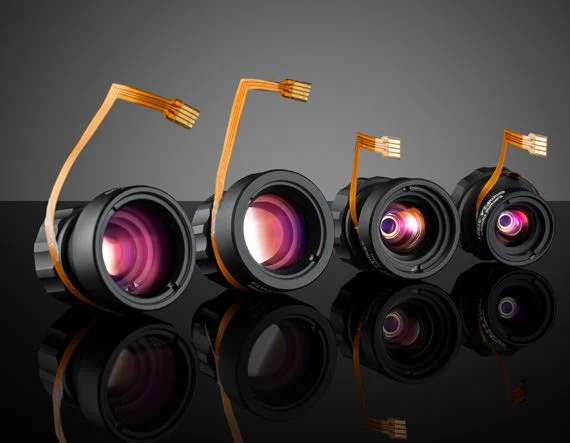
TECHSPEC® Liquid Lens M12 Imaging Lenses

Jimmy Carroll: [00:11:55] Yeah, SWIR is an interesting one. We were talking to a number of folks at the show the last couple of days on SWIR and kind of echoed that sentiment of it’s back. It’s not new.

John Lewis: [00:12:13] It’s gotten to the price point where people can access it.

Randall Hinton: [00:12:15] Right. It’s accessible.

Jimmy Carroll: [00:12:17] Yeah, and beyond Sony and the SenSWIR sensor and the camera companies who incorporate it, it’s companies like Edmund too that are enabling these systems to solve new problems or make things faster, more efficient in whatever, food and beverage or fill level or inspecting contents through plastic or whatever it might be.

Randall Hinton: [00:12:43] Kind of a different market from that is, next week is the Society for Laboratory Automation and Screening. So again, this whole other industry that has those automation and looking at live cell cultures. And so the other application I saw SWIR in recently was, the company is called Cision — like you’re cutting — Vision. And so just this whole world of pathology I just learned about, where your biopsy goes to a lab, and you have these pathologists’ assistants picking out lymph nodes. Lymph nodes are indicative of cancer spreading. And so part of that process is pulling out these lymph nodes from this fatty tissue. And very manual. It all looks the same. And so this company, basic imaging concepts. What is SWIR? SWIR’s a longer wavelength. It penetrates more. It has less scattering. There’s these lymph nodes versus fatty tissue. There’s that water content difference, again sensitive to SWIR. And then they took basic concepts of cross-polarization, illumination. And again, these two tissues: one’s birefringent. The other isn’t. And so again that that modifies, that changes the incident polarization to again give you more contrast. And so when you show the picture of their system and live image, boom, the lymph nodes just pop right out, these black spots in this field of white, just really making the pathologist’s life faster and easier to get those lymph nodes and get them processed, to get them to slides for analysis and disease diagnosis.

John Lewis: [00:14:33] Yeah, I know, waiting for results. Very stressful time for many people I know who have cancer and other things. And the faster we can make that happen, the easier it is on everyone.

Jimmy Carroll: [00:14:46] Yeah I mean it puts things in perspective, right? It’s like anybody in their job wants to be able to succeed and do a good job and serve their customers. But like, yes, it would be nice to not find a rock in my brown rice. And it’s much more important when you’re helping somebody when when it comes to a potential cancer diagnosis. The work is in a lot of ways more meaningful intrinsically.

Randall Hinton: [00:15:10] And there’s another customer in that space, FormaPath. And they have an innovative way to get the lymph nodes out of that tissue. Not necessarily an imaging method, but they are working on some machine learning technologies to help that process go along.

Jimmy Carroll: [00:15:34] Randall, what else haven’t we talked about today — what’s Edmund most excited about at Photonics West? Anything that we haven’t covered?

Randall Hinton: [00:15:40] Yeah, again, just that idea that we have a marketplace of not just products that we manufacture but partnering with,  whether it be camera brands or illumination or other microscopy folks, where those two do come together and related to automation and pathology, one partner, Zaber, on the translation side, and we’ve partnered with them with a new microscope objective that we’ve done and designed and manufactured in Tucson. And so we work with them together for an automated microscope. So with a little bit of Python programming, you can set that and run and process slides, scan through those slides, and X, Y, and Z travel. So I’m really excited about that too.

Jimmy Carroll: [00:16:34] Cool. John, anything else from your end?

John Lewis: [00:16:35] Nothing for me.

Jimmy Carroll: [00:16:36] Well, I believe it’s edmundoptics.com if people want to learn more. Obviously, LinkedIn. If you have any questions for Randall, we’d be happy to pass those along. You can reach us at manufacturing-matters.com. And thanks for checking this out.