Episode 77 – Alex Fong, CTO, Hinalea Imaging

Hyperspectral imaging has been around for decades, but new capabilities are taking the technology to whole new levels. In this episode of Manufacturing Matters, TECH B2B Marketing’s Jimmy Carroll and John Lewis sat down with Alex Fong, CTO at Hinalea Imaging, to talk about where the technology is heading. Hinalea uses a Fabry-Pérot interferometry approach that provides extreme versatility — very quickly collecting entire high-resolution ranges from the visible through near infrared, shortwave infrared (SWIR), even up into ultraviolet. Fong details the wide range of applications this enables — from monitoring critical processes in real time to detecting hazards quickly — as well as what is making SWIR technologies so popular.
Hinalea Imaging

Episode 77 – Alex Fong, CTO, Hinalea Imaging BK (2).m4a: Audio automatically transcribed by Sonix

Episode 77 – Alex Fong, CTO, Hinalea Imaging BK (2).m4a: this m4a audio file was automatically transcribed by Sonix with the best speech-to-text algorithms. This transcript may contain errors.

Jimmy Carroll:
Hi everybody. My name is Jimmy Carroll. I’m the vice president of operations at tech B2B marketing. I’m here at SPI Photonics West 2024. I have the pleasure of being joined by Alex Fong and my colleague John Lewis. Alex, thanks so much for taking the time today.

Alex Fong:
Absolute pleasure.

Jimmy Carroll:
So we’re here today to talk about Himalaya Imaging. For those who don’t know, could you give us a little background and let us know what you’re most excited about right now?

Alex Fong:
Okay. Well, basically we have a sort of a disruptive technology when it comes to hyperspectral imaging. So hyperspectral imaging has been around for quite some time. It’s actually a spin off of the NASA’s satellite programs. They were doing it with these things called the Pushbroom grating. Well, first they did it just with different filter cameras, but then they went into using gratings. Basically, you can consider it a spectrometer pointed down and then capturing the spectra for a line of an image as it scans across the Earth and some sort of orbit. Well, fast forward to now. We’ve developed this technology based on Fabry-perot variable airlines, and it’s basically the most sort of versatile approach that exists. We can collect entire high resolution ranges from throughout the visible through the near throughout the shortwave infrared, even up to the UV. We can cut down the number of bands. We can choose which bands we want to take. We can collect things like a in a snapshot mode. So take a picture like a camera, or we can do it in real time, where we stream out specific bands and collect all the spectra for an image for every pixel continuously. So this allows us to be used in all sorts of applications. We can monitor manufacturing processes or critical processes in real time. It can be used for security, surveillance and defense applications to point out hazards, and then it can also be used in research where you need extremely high precision, high resolution spectral and spatial information of an image or of a of a specimen.
Speaker3:
A couple of terms that I’ve, I’ve been confused about in the past. The difference between hyperspectral and multispectral. Can you can you talk a little about a bit about that and clarify for us?

Alex Fong:
Sure, sure. And you’ve given me the entree to give a nod to an IEEE committee online. I’m sure my colleague Chris Turrell and and his friends on that will be thrilled. So there’s an IEEE committee for the standardization of hyperspectral imaging terms and methods. And I think we’ve defined it essentially as multispectral being in the tens of bands, whereas hyperspectral is in the hundreds plus of bands. So it’s really a resolution. Figure of merit. So at one point, if you’re, you know, somewhere between like 4 to 20, then you’re multispectral. Once you go past like 20 or 30 or 40 or whatever, and you’re into the hundreds, then you’re hyperspectral.

Jimmy Carroll:
Contiguous bands, right?

Alex Fong:
Yeah. Basically. Um, and that’s a good point because multispectral tends to be discrete, sort of separated bands. You’ve got typically channels. So the way to think about it is channels versus this sort of more almost continuous, but it’s also discrete but almost continuous sort of range of values.

Jimmy Carroll:
So here I want to talk about SWR. And that’s something that can kind of go for depending on who you ask. It might be multispectral. It might be hyperspectral. Um, it really seems to be. And this kind of speaks I will back up for a second is you mentioned it, but but hyperspectral has gone from something really large and expensive in the lab to something that’s I don’t I haven’t seen a camera up close, but I imagine they’re, you know, not much larger than this. Maybe smaller and much less expensive. Right. Which has obviously led beyond. Beyond. There’s a number of other factors here, but this has led to increased adoption of hyperspectral multispectral technologies in on the factory floor in industrial automation, things like that. Um, what what are some ways that you’re seeing sphere used. Right. Because for some reason, it seems that sphere is really gaining steam over the last couple of years. Right?

Alex Fong:
Absolutely. And for good reason. So visible in air is exactly what it sounds like. You know, it’s what your eye can see, plus a little bit more beyond it. And there’s a lot of information there. Um, certainly your eye cannot parse out these, you know, little spectral bands at four nanometer resolution, which is our resolution without that instrument. Um, so these sort of fine gradations in between the wavelengths. Um, but there’s a lot of information outside of what our eyes can see. And shortwave infrared. That’s where that takes us. So we can take a look at, for example, an array of white powders. We can distinguish between different pharmaceutical products. If you put down acetaminophen, which is commonly known as Tylenol, etc., aspirin, um, a couple of other sort of antibiotics, things like that. If you put them all down and you use your shortwave infrared camera equipped with some sort of spectral filter or etalon, as in our case, you can totally distinguish them very clearly. Their spectral profiles or signatures are quite different from one another. So um, using that plus add some machine learning to it, you know, some classifiers, all of a sudden you can false color the, you know, acetaminophen is different than the aspirin. It’s different from the baking soda. It’s different from the sugars. It’s different from the salt. All of it becomes, um, completely detectable. If it was a palette of colors.

Alex Fong:
Um, where now this becomes useful. For example, we did a nice application with the Electric Power Research Institute, um, where we used it in a test trial to see if we could identify corrosion type of in a type of corrosion called the boric acid corrosion from nuclear power reactor heads. So these small cracks occur in, you know, under high pressure. Um, and because boron is used as a moderator, that’s what leaches out. And it causes a sort of white powder corrosion. But there’s a lot of white powders in the nuclear power plant. There’s gypsum and other, you know, uh, white things that are white. So if you could, if you can come up with some sort of way to differentiate between them, then you have an effective tool to detect these leaks. Well, we were able to do that. And and that’s online. We can, you know, share the paper and everything. But um, not only were we able to do it like taking take a snapshot and do that with a lot of bands. We could do it with less bands and to the point where we could put it on what’s called a crawler, which is a type of rover and in real time, basically swivel the camera and look at that tube and see where the loops are, and then highlight that. And using machine learning classifiers, highlight that in red.

Jimmy Carroll:
Yeah, yeah that’s really interesting right. When I think of some of this is maybe my own bias, but when I think of like industrial applications and swear and kind of non-visible imaging in general, one of the applications I think of is is food and beverage, right. So would it be safe to say that if somebody is going to make a lentil soup at home and if they if they open up the lentils and there’s and there’s no rocks in there, that there’s a chance that a sewer camera helped identify those rocks and sort them out and that.

Alex Fong:
Kind of thing. Yeah, that’s a common that’s a common ask, which is it’s even got an acronym for foreign object detection. It’s huge. Um, we worked with a company that makes, uh, snack item. I can’t really say. Um. And the snack item involves potatoes. And when you’re growing potatoes, apparently there’s a lot of things that look like potatoes that get harvested, including golf balls and pieces of wood, etc. and so they were looking for a tool, basically that could tell their golf ball from a peeled potato from a piece of wood. Yeah, these other things. And as it happens, fortunately potatoes and golf balls and pieces of wood and rubber have different spectral signatures from one another. So it was easy to sort of highlight as red things that were not potato. Yeah.

Jimmy Carroll:
Yeah. So remember, next time you open a bag of snacks or a bag of lentils or something like this and there’s nothing funny in there, then it’s probably been seen by some sort of non-visible.

Alex Fong:
You don’t see a title sitting in there?

Jimmy Carroll:
Yeah, yeah. You certainly don’t want to bite into one of those.

Speaker3:
Yeah. So I’m curious, you know, we talked about food and beverage pharmaceuticals. Uh, um, are there other applications that are maybe up and coming Where hyperspectral imaging may have found application in the future.

Alex Fong:
Oh, absolutely. I mean, the big ones are all in ag and food production. Um, and those are very exciting and important. I mean, I, I can’t stress enough the impact. Um, obviously the public health, safety and health, but also just in terms of cost, because if you have a situation where something that’s contaminated with some sort of pathogen gets out, um, the current sort of turnaround time with most sort of assay or, you know, biochemical molecular technologies is like 72 hours or something like that. A lot of damage gets done in 72 hours. So we are working with, for example, the USDA on some projects to, uh, shorten that turnaround time. Um, conceivably we want to hit something below the eight hour mark. So if we can turn things around within, let’s say four hours, that saves a lot of lives. Public health and saves tremendous cost for manufacturers and for everybody involved in the food chain. So so that’s really exciting to us. The other side of it is also applications where we are detecting hazards. So right now we’re in a project with the Department of Defense. We’re looking at a way of detecting munitions essentially on the ground explosives. And this is an older problem actually that’s been around since probably, I think, the Iraq war where people were interested in detecting IEDs. But now the technology and in particular the the machine learning or AI type of developments combined with hyperspectral technology that’s available is making it possible for us to actually interpret the information on a timely basis. So what that means is kind of like that nuclear reactor head application. We can put this on a on a robot, drive it around, look at boxes, cars, things like that, and say, Okay. That’s probably safe. Or. Okay, we better get everybody out of here. And I think what it comes down to, somebody once asked, what do you sum up the sort of mission of of Himalaya imaging? And it’s really it’s, you know, human safety really it’s quality of life. We’re trying to make sure people are safe and and healthy. And so that’s a common thread of what we do.

Jimmy Carroll:
I guess. Oh sorry John. Go ahead. I was just going.

Speaker3:
To say what differentiates their technology from, say, other hyperspectral imaging technologies that are out.

Alex Fong:
There. I think it’s flexibility. So the the big one, you know, you see out there the most ubiquitous hyperspectral imaging technologies are pushbroom. So these are basically, as I said before, it’s really an adaptation of that technology that NASA pioneered for satellites. So you have a grating, a slit. It’s a spectrometer. You tilt it on its side, you sweep it across a field of view, and you get the image very high resolution, but the time that it takes for you to sweep that area, things can change from one side to the next. The other technologies are basically digital versions of a filter wheel. So you’re rotating around a filter wheel, getting the different bands. So there’s time expended there. There’s reliability issues if you make it solid state. So there’s liquid crystal tunable filters or acousto optic tunable filters one band at a time. Not good transmission. The the spin that we bring to it is we use an avalanche. Two mirrors. That’s how you select a wavelength. But we can transmit more than one band at a time. So we’re collecting a lot of bands at, at at any given point. So we can collect a lot of information very quickly, um, with minimal sort of, um, transmission loss. And you can choose which bands you want. You don’t have to have all 300 bands across the entire range, and you get the entire image at that point.

Speaker3:
So is there a maximum number of bands an upper limit?

Alex Fong:
Well, basically it’s proportional to the time that you can tolerate for acquiring that information. So for example we can collect about ten bands and a percent. So we call it hypercubes right. So instead of frames hypercubes for seconds. So ten hypercubes per second is currently what we can do. If we increase the amount of light shorten the exposure we can probably collect even more. So these are sort of variables that you can play with. Um, whereas with other stuff you know, you’re kind of yeah, your exposure determines, you know, whether or not you collect that line with the pushbroom, but you’re going to collect all 300 bands and it’s going to take you that long to mechanically scan across the image. We don’t have such limitations.

Jimmy Carroll:
What. So that technology we kind of touched on from the application standpoint, we touched on some of the main ones, but any are there any industries or applications that you see as being like hyperspectral imaging have having a future in um.

Alex Fong:
Sky’s the limit, really as we move outside of the visible and IR, which was the traditional sort of spectral range into the shortwave infrared and we can go out into the mid-wave IR long wave IR. And this is contingent on other technologies, detectors and everything, the image sensors. But we’re also going to UV. So that opens UV opens up a lot of new application areas in solid state electronics and things like that. So yeah, there is any number of things that we have yet to see that have yet to be explored. Um, one of the joys I think, of, of my career in photonics has been that we work with great customers and, um, people will, you know, often in other industries, people can complain about their customers, but I don’t I love the fact that they come up with a new challenge for me every day, because the worst you can do is just to say, “I can’t do that.” But most of the time there’s something you can do and the fun is trying to figure out how you get there. And there’s always something interesting. And I’ve discovered—— We’ve discovered, collectively, at Himalaya all sorts of new ways to solve problems.

Jimmy Carroll:
Very cool. Alex, or John, for that matter… Anything else we haven’t talked about or anything else you haven’t asked about that we want to cover today?

Alex Fong:
No, just, you know, check us out at Hinalea.com. H-I-N-A-L-E-A.com. And that’s it. We’re based in Emeryville, California, just 15 minutes out of Berkeley.

Jimmy Carroll:
Well, you heard it——If anyone has any questions for Alex specifically, they can reach out to us. And you can reach out to us via the podcast website, which is Manufacturing-Matters.com. Any general comments, questions, or even requests to come join the podcast——please feel free to reach out to us. And thanks for either listening or watching.

Sonix is the world’s most advanced automated transcription, translation, and subtitling platform. Fast, accurate, and affordable.

Automatically convert your m4a files to text (txt file), Microsoft Word (docx file), and SubRip Subtitle (srt file) in minutes.

Sonix has many features that you’d love including world-class support, automated subtitles, share transcripts, secure transcription and file storage, and easily transcribe your Zoom meetings. Try Sonix for free today.

Jimmy Carroll: [00:00:07] Hi everybody. My name is Jimmy Carroll. I’m the vice president of operations at tech B2B marketing. I’m here at SPI Photonics West 2024. I have the pleasure of being joined by Alex Fong and my colleague John Lewis. Alex, thanks so much for taking the time today.

Alex Fong: [00:00:21] Absolute pleasure.

Jimmy Carroll: [00:00:22] So we’re here today to talk about Himalaya Imaging. For those who don’t know, could you give us a little background and let us know what you’re most excited about right now?

Alex Fong: [00:00:30] Okay. Well, basically we have a sort of a disruptive technology when it comes to hyperspectral imaging. So hyperspectral imaging has been around for quite some time. It’s actually a spin off of the NASA’s satellite programs. They were doing it with these things called the Pushbroom grating. Well, first they did it just with different filter cameras, but then they went into using gratings. Basically, you can consider it a spectrometer pointed down and then capturing the spectra for a line of an image as it scans across the Earth and some sort of orbit. Well, fast forward to now. We’ve developed this technology based on Fabry-perot variable airlines, and it’s basically the most sort of versatile approach that exists. We can collect entire high resolution ranges from throughout the visible through the near throughout the shortwave infrared, even up to the UV. We can cut down the number of bands. We can choose which bands we want to take. We can collect things like a in a snapshot mode. So take a picture like a camera, or we can do it in real time, where we stream out specific bands and collect all the spectra for an image for every pixel continuously. So this allows us to be used in all sorts of applications. We can monitor manufacturing processes or critical processes in real time. It can be used for security, surveillance and defense applications to point out hazards, and then it can also be used in research where you need extremely high precision, high resolution spectral and spatial information of an image or of a of a specimen.

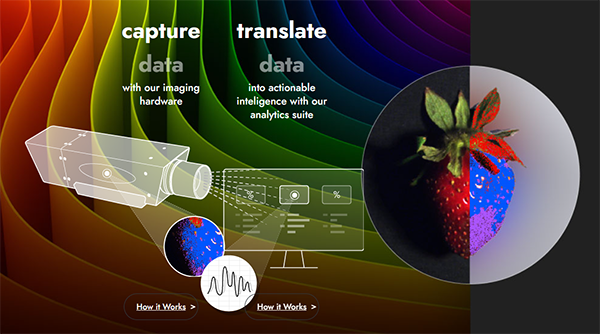
Example of capture data with our imaging hardware and a camera capturing data

John Lewis: [00:02:17] A couple of terms that I’ve, I’ve been confused about in the past. The difference between hyperspectral and multispectral. Can you can you talk a little about a bit about that and clarify for us?

Alex Fong: [00:02:29] Sure, sure. And you’ve given me the entree to give a nod to an IEEE committee online. I’m sure my colleague Chris Turrell and and his friends on that will be thrilled. So there’s an IEEE committee for the standardization of hyperspectral imaging terms and methods. And I think we’ve defined it essentially as multispectral being in the tens of bands, whereas hyperspectral is in the hundreds plus of bands. So it’s really a resolution. Figure of merit. So at one point, if you’re, you know, somewhere between like 4 to 20, then you’re multispectral. Once you go past like 20 or 30 or 40 or whatever, and you’re into the hundreds, then you’re hyperspectral.

Jimmy Carroll: [00:03:13] Contiguous bands, right?

Alex Fong: [00:03:15] Yeah. Basically. Um, and that’s a good point because multispectral tends to be discrete, sort of separated bands. You’ve got typically channels. So the way to think about it is channels versus this sort of more almost continuous, but it’s also discrete but almost continuous sort of range of values.

Jimmy Carroll: [00:03:36] So here I want to talk about SWR. And that’s something that can kind of go for depending on who you ask. It might be multispectral. It might be hyperspectral. Um, it really seems to be. And this kind of speaks I will back up for a second is you mentioned it, but but hyperspectral has gone from something really large and expensive in the lab to something that’s I don’t I haven’t seen a camera up close, but I imagine they’re, you know, not much larger than this. Maybe smaller and much less expensive. Right. Which has obviously led beyond. Beyond. There’s a number of other factors here, but this has led to increased adoption of hyperspectral multispectral technologies in on the factory floor in industrial automation, things like that. Um, what what are some ways that you’re seeing sphere used. Right. Because for some reason, it seems that sphere is really gaining steam over the last couple of years. Right?

Alex Fong: [00:04:27] Absolutely. And for good reason. So visible in air is exactly what it sounds like. You know, it’s what your eye can see, plus a little bit more beyond it. And there’s a lot of information there. Um, certainly your eye cannot parse out these, you know, little spectral bands at four nanometer resolution, which is our resolution without that instrument. Um, so these sort of fine gradations in between the wavelengths. Um, but there’s a lot of information outside of what our eyes can see. And shortwave infrared. That’s where that takes us. So we can take a look at, for example, an array of white powders. We can distinguish between different pharmaceutical products. If you put down acetaminophen, which is commonly known as Tylenol, etc., aspirin, um, a couple of other sort of antibiotics, things like that. If you put them all down and you use your shortwave infrared camera equipped with some sort of spectral filter or etalon, as in our case, you can totally distinguish them very clearly. Their spectral profiles or signatures are quite different from one another. So um, using that plus add some machine learning to it, you know, some classifiers, all of a sudden you can false color the, you know, acetaminophen is different than the aspirin. It’s different from the baking soda. It’s different from the sugars. It’s different from the salt. All of it becomes, um, completely detectable. If it was a palette of colors.

Alex Fong: [00:05:57] Um, where now this becomes useful. For example, we did a nice application with the Electric Power Research Institute, um, where we used it in a test trial to see if we could identify corrosion type of in a type of corrosion called the boric acid corrosion from nuclear power reactor heads. So these small cracks occur in, you know, under high pressure. Um, and because boron is used as a moderator, that’s what leaches out. And it causes a sort of white powder corrosion. But there’s a lot of white powders in the nuclear power plant. There’s gypsum and other, you know, uh, white things that are white. So if you could, if you can come up with some sort of way to differentiate between them, then you have an effective tool to detect these leaks. Well, we were able to do that. And and that’s online. We can, you know, share the paper and everything. But um, not only were we able to do it like taking take a snapshot and do that with a lot of bands. We could do it with less bands and to the point where we could put it on what’s called a crawler, which is a type of rover and in real time, basically swivel the camera and look at that tube and see where the loops are, and then highlight that. And using machine learning classifiers, highlight that in red.

Jimmy Carroll: [00:07:13] Yeah, yeah that’s really interesting right. When I think of some of this is maybe my own bias, but when I think of like industrial applications and swear and kind of non-visible imaging in general, one of the applications I think of is is food and beverage, right. So would it be safe to say that if somebody is going to make a lentil soup at home and if they if they open up the lentils and there’s and there’s no rocks in there, that there’s a chance that a sewer camera helped identify those rocks and sort them out and that.

Alex Fong: [00:07:42] Kind of thing. Yeah, that’s a common that’s a common ask, which is it’s even got an acronym for foreign object detection. It’s huge. Um, we worked with a company that makes, uh, snack item. I can’t really say. Um. And the snack item involves potatoes. And when you’re growing potatoes, apparently there’s a lot of things that look like potatoes that get harvested, including golf balls and pieces of wood, etc. and so they were looking for a tool, basically that could tell their golf ball from a peeled potato from a piece of wood. Yeah, these other things. And as it happens, fortunately potatoes and golf balls and pieces of wood and rubber have different spectral signatures from one another. So it was easy to sort of highlight as red things that were not potato. Yeah.

Jimmy Carroll: [00:08:29] Yeah. So remember, next time you open a bag of snacks or a bag of lentils or something like this and there’s nothing funny in there, then it’s probably been seen by some sort of non-visible.

Alex Fong: [00:08:38] You don’t see a title sitting in there?

Jimmy Carroll: [00:08:41] Yeah, yeah. You certainly don’t want to bite into one of those.

John Lewis: [00:08:46] Yeah. So I’m curious, you know, we talked about food and beverage pharmaceuticals. Uh, um, are there other applications that are maybe up and coming Where hyperspectral imaging may have found application in the future.

Alex Fong: [00:08:59] Oh, absolutely. I mean, the big ones are all in ag and food production. Um, and those are very exciting and important. I mean, I, I can’t stress enough the impact. Um, obviously the public health, safety and health, but also just in terms of cost, because if you have a situation where something that’s contaminated with some sort of pathogen gets out, um, the current sort of turnaround time with most sort of assay or, you know, biochemical molecular technologies is like 72 hours or something like that. A lot of damage gets done in 72 hours. So we are working with, for example, the USDA on some projects to, uh, shorten that turnaround time. Um, conceivably we want to hit something below the eight hour mark. So if we can turn things around within, let’s say four hours, that saves a lot of lives. Public health and saves tremendous cost for manufacturers and for everybody involved in the food chain. So so that’s really exciting to us. The other side of it is also applications where we are detecting hazards. So right now we’re in a project with the Department of Defense. We’re looking at a way of detecting munitions essentially on the ground explosives. And this is an older problem actually that’s been around since probably, I think, the Iraq war where people were interested in detecting IEDs. But now the technology and in particular the the machine learning or AI type of developments combined with hyperspectral technology that’s available is making it possible for us to actually interpret the information on a timely basis. So what that means is kind of like that nuclear reactor head application. We can put this on a on a robot, drive it around, look at boxes, cars, things like that, and say, Okay. That’s probably safe. Or. Okay, we better get everybody out of here. And I think what it comes down to, somebody once asked, what do you sum up the sort of mission of of Himalaya imaging? And it’s really it’s, you know, human safety really it’s quality of life. We’re trying to make sure people are safe and and healthy. And so that’s a common thread of what we do.

Hyperspectral Microscopy

Jimmy Carroll: [00:11:18] I guess. Oh sorry John. Go ahead. I was just going.

John Lewis: [00:11:20] To say what differentiates their technology from, say, other hyperspectral imaging technologies that are out.

Alex Fong: [00:11:26] There. I think it’s flexibility. So the the big one, you know, you see out there the most ubiquitous hyperspectral imaging technologies are pushbroom. So these are basically, as I said before, it’s really an adaptation of that technology that NASA pioneered for satellites. So you have a grating, a slit. It’s a spectrometer. You tilt it on its side, you sweep it across a field of view, and you get the image very high resolution, but the time that it takes for you to sweep that area, things can change from one side to the next. The other technologies are basically digital versions of a filter wheel. So you’re rotating around a filter wheel, getting the different bands. So there’s time expended there. There’s reliability issues if you make it solid state. So there’s liquid crystal tunable filters or acousto optic tunable filters one band at a time. Not good transmission. The the spin that we bring to it is we use an avalanche. Two mirrors. That’s how you select a wavelength. But we can transmit more than one band at a time. So we’re collecting a lot of bands at, at at any given point. So we can collect a lot of information very quickly, um, with minimal sort of, um, transmission loss. And you can choose which bands you want. You don’t have to have all 300 bands across the entire range, and you get the entire image at that point.

John Lewis: [00:12:50] So is there a maximum number of bands an upper limit?

Alex Fong: [00:12:53] Well, basically it’s proportional to the time that you can tolerate for acquiring that information. So for example we can collect about ten bands and a percent. So we call it hypercubes right. So instead of frames hypercubes for seconds. So ten hypercubes per second is currently what we can do. If we increase the amount of light shorten the exposure we can probably collect even more. So these are sort of variables that you can play with. Um, whereas with other stuff you know, you’re kind of yeah, your exposure determines, you know, whether or not you collect that line with the pushbroom, but you’re going to collect all 300 bands and it’s going to take you that long to mechanically scan across the image. We don’t have such limitations.

Jimmy Carroll: [00:13:39] What. So that technology we kind of touched on from the application standpoint, we touched on some of the main ones, but any are there any industries or applications that you see as being like hyperspectral imaging have having a future in um.

Alex Fong: [00:13:56] Sky’s the limit, really as we move outside of the visible and IR, which was the traditional sort of spectral range into the shortwave infrared and we can go out into the mid-wave IR long wave IR. And this is contingent on other technologies, detectors and everything, the image sensors. But we’re also going to UV. So that opens UV opens up a lot of new application areas in solid state electronics and things like that. So yeah, there is any number of things that we have yet to see that have yet to be explored. Um, one of the joys I think, of, of my career in photonics has been that we work with great customers and, um, people will, you know, often in other industries, people can complain about their customers, but I don’t I love the fact that they come up with a new challenge for me every day, because the worst you can do is just to say, “I can’t do that.” But most of the time there’s something you can do and the fun is trying to figure out how you get there. And there’s always something interesting. And I’ve discovered—— We’ve discovered, collectively, at Himalaya all sorts of new ways to solve problems.

Jimmy Carroll: [00:15:05] Very cool. Alex, or John, for that matter… Anything else we haven’t talked about or anything else you haven’t asked about that we want to cover today?

Alex Fong: [00:15:14] No, just, you know, check us out at Hinalea.com. H-I-N-A-L-E-A.com. And that’s it. We’re based in Emeryville, California, just 15 minutes out of Berkeley.

Jimmy Carroll: [00:15:28] Well, you heard it——If anyone has any questions for Alex specifically, they can reach out to us. And you can reach out to us via the podcast website, which is Manufacturing-Matters.com. Any general comments, questions, or even requests to come join the podcast——please feel free to reach out to us. And thanks for either listening or watching.