Episode 67 — Fritz Carlson, CEO, Acme Manufacturing

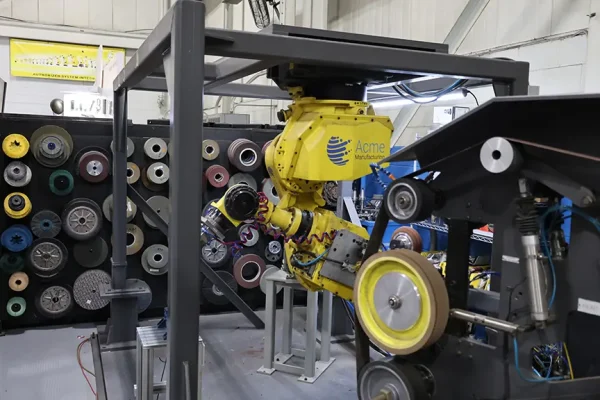
In this episode of Manufacturing Matters, Fritz Carlson, CEO of Acme Manufacturing, joins TECH B2B Marketing’s Winn Hardin and Jimmy Carroll to discuss robotic machine tooling integrations around the globe. They discuss the benefits of industrial robot arms paired with sensing mechanisms for highly accurate and repeatable machining of complex parts, such as knee and hip implants in the medical devices field and jet engine parts in aerospace. They highlight the labor shortage affecting manufacturers around the world and how it’s driving demand of easy-to-use automated solutions.
Acme manufacturing

Episode 67 — Fritz Carlson, CEO, Acme Manufacturing PG.mp4: Audio automatically transcribed by Sonix

Episode 67 — Fritz Carlson, CEO, Acme Manufacturing PG.mp4: this mp4 audio file was automatically transcribed by Sonix with the best speech-to-text algorithms. This transcript may contain errors.

Jimmy Carroll:
Hi everybody. My name is Jimmy Carroll. I’m the vice president of operations at Tech B2B Marketing. I’m here on the Manufacturing Matters podcast. I have the pleasure of being joined by Fritz Carlson of Acme Manufacturing and my colleague Winn Hardin. Fritz, I want to thank you for taking the time. Really appreciate it. For those who don’t know out there, if you could give us some background on Acme Manufacturing, a historic company, you’ve been around for a while. If you could let us know what you guys do and what you do there, that would be helpful.

Fritz Carlson:
So our expertise is really in material removal. So it’s grinding, polishing, buffing, and deburring. We’re really a machine tool builder by foundation. The company was founded in 1910 by my great-grandfather. So I’m generation four. And I’ve been with the company, this would be my 40th year. And so we build material removal solutions, but we build special machinery too. Most of our business is now robotic systems, and we sell to about 20 industries globally. We have a company in Singapore that we started in 2019 that focuses mainly on aviation and the maintenance, repair, overhaul market. But we’ve sold equipment all over Asia, Europe, Brazil, and North America, and we’ve integrated close to 4,000 robot systems since 1987.

Winn Hardin:
Is that aerospace application primarily paint removal?

Fritz Carlson:
It’s all jet engine work. It’s all jet engine components, which are very, very expensive castings and/or forgings that are typically titanium or Inconel. And so, it’s great for ROI when you’re dealing with high-value parts. So we like to focus on very expensive parts, whether they get implanted in a human body or they go into a jet engine. That’s where you see the best return on investments versus very inexpensive parts like consumer products, hand tools, stuff like that. It’s amazing how expensive some of the components are that go into the jet engine. Probably one of the most expensive is probably about three quarters of a million dollars. So when you’re working on a three-quarter of a million dollar part, the last thing you want to do is scrap it.

Winn Hardin:
I was going to say, waste really becomes a problem. Is this a large part or it’s just a highly complex part?

Fritz Carlson:
It called a blisk. And it’s one of the stages within a jet engine. And it can be several feet in diameter. And it’s generally titanium or Inconel, and it’s very, very expensive.

Winn Hardin:
You mentioned earlier when we were talking really briefly right before the show that biomed is really big for you guys.

Fritz Carlson:
Yeah, we do a lot in the medical device market. We do a lot of polishing on knee implants as well as hip implants. Hip heads. Hip cuffs. Some shoulder domes. That’s been a great industry for us, just because historically that would all be polished by hand. So you’d have a room full of hand polishers. And it’s interesting that one robot cell working three shifts a day will produce as many parts as what 18 people can do by hand. But the robot’s going to do it much more repeatably, much more accurately. And you’re going to keep your unit costs as low as possible. Whereas when you do anything by hand, it’s really up to each individual person how they do it. It’s really an art.

Winn Hardin:
Which probably even makes that labor gap even more difficult to fill.

Fritz Carlson:
Yeah. And the other thing today, you’ve got a lot of people that were . . . like I’m a boomer, so you’ve got boomers that maybe were hand polishers for entire 30, 35 years, and now they’re retiring. So now you go to replace that person. Do you think you’re going to find a Gen Z or millennial that wants to be a hand polisher? I would say you’re not going to find one.

Winn Hardin:
It’s going to be a hard ask.

Fritz Carlson:
So it just drives automation.

Winn Hardin:
Plus in biomed, you were saying, the numbers are massive, right?

Fritz Carlson:
Yeah. There’s 80 million baby boomers in the United States. Statistically, in your lifetime, you’ll need at least two implants. That’s only in the US. That’s 160 million implants. And then you’ve got Latin America, you’ve got Europe, you have Asia. And that’s just a growing demographic.

Winn Hardin:
Outstanding.

Fritz Carlson:
So that’s a great industry to be in.

Jimmy Carroll:
Yeah. You know, the automation landscape is obviously constantly evolving and responding to customer needs. With you guys serving so many different industries, from medical to automotive to some of the other ones we talked about before, how do you guys go about responding to these customer needs and how does that impact product development?

Fritz Carlson:
Well, generally what we try and do is we try and develop tools, equipment that can be repurposed over a variety of industries. What we try to stay away from is what we call one and done. So you design something special once, but you can’t — there’s no market to sell it again. And so you never really get your engineering investment back.

Winn Hardin:
That or you have to charge the clients an astronomical amount.

Fritz Carlson:
Exactly, versus if we can design a belt polishing head or a buffing head that we can use in medical but we can use it in hand tools and we can use it in plumbing or we can use it in other industry. In our business, the more you can repurpose existing engineering, the better your margins are and the quicker we can get equipment to market versus having to design something new all the time.

Winn Hardin:
More cobots than traditional robots or the other way around?

Fritz Carlson:
You know, because of material removal and the dangers with just grinding and polishing and buffing, we have not been successful with cobots. So most of all the systems that we do are industrial robots.

Winn Hardin:
Different, difficult environment.

Fritz Carlson:
It’s a very different environment. And so up to this point we have not had success trying to implement cobots, so our focus really is using industrial arms, and we use anything from a 7 kilogram arm up to a 2,300 kilogram arm, depending on the application.

Winn Hardin:
You know, part of what you’ve heard over the years with cobots is that positional accuracy, right, and vibration dampening and things like that. So is that, depending on the application?

Fritz Carlson:
For what we’re doing, because there’s so much compliance in the media that we use, whether it’s a buffing wheel or whether it’s coated abrasive, whether it’s non-woven. And then a lot of our finishing heads, we have compliance built into them. The contact wheels have different durometers, different hardnesses. So there’s a lot of things that compensate for having to be accurate. And even vibration, there’s just so many things that you want to have as much compliance as possible. Because in a lot of cases these parts are not very accurate, especially with forgings and castings. And the robot doesn’t have eyes. Whereas the human, when it was that human is polishing, it can work the part whereas the robot can’t. So we need to include tools into our systems that will provide that compliance so that the robot doesn’t need vision.

Jimmy Carroll:
Different ways to sense the part and the diameter.

Fritz Carlson:
We use all sorts of prox switches. We use lasers. We have a toolbox of options that we have, and it’s really kind of tailored to the application.

Jimmy Carroll:
That kind of ties into a question I wanted to ask you. You have a unique position as you’re a machine tooling company but also an integrator. Maybe this is an obvious thing, but there’s a lot of technologies that are kind of advancing in lockstep to solve new problems for the customers as automation demands grow. And are there any key examples that you can think of these technologies, like advancing your systems, adding new capabilities, making them faster, more accurate, things like that?

Fritz Carlson:
We definitely have. I mean, we developed a technology in Singapore in the last three years. We call it Auto Path Generation, and it is a game changer. And right now we’re trying to implement it with other applications that we sell at Acme. Because what it does is it takes the need of a robot programmer away. The robot basically picks up a part. And in the MRO world, every part is different because they’ve been repaired. And just through a series of scanning moves that we do, we can create a perfect part program based on every single part that we run. Every single part is different. So it’s absolutely game changing. We’re working very feverishly right now to roll this out into other applications for other parts.

Winn Hardin:
Is that using any AI/deep learning in there?

Fritz Carlson:
It is. It’s using AI, it’s using machine learning, and I’m fortunate that I have a very talented team at Acme. They’re engineers. They’re programmers. They understand process. They understand software. And you put all those people together and it’s pretty exciting what you end up with. Because at the end of the day, it’s all about ease of use. And so most of the systems that we’ve built over the last 30-some years . . .

Winn Hardin:
A fraction of your company lifetime.

Fritz Carlson:
You can’t hire somebody off the street and say, okay, run this Acme robot. So you have to train them. And sometimes some of the stuff that we do is pretty complex. So really what we’re pushing right now is we’re trying to create solutions that are easier to use than they used to be. So any way that we can develop tools that can make the end user, make their experience better, that’s what it’s all about. And hopefully, then people won’t be afraid to implement. They say, “Wow, it’s complicated.” Well, it doesn’t have to be complicated. So we are really, really pushing that initiative right now.

Jimmy Carroll:
“Ease of use” is a term that’s come up a lot. And again, perhaps it’s an obvious one. Everything should be easier to use, right? But I personally see it as a big growth driver in automation adoption. And some of these figures you see from A3 or interactive analysis of some of these other companies. Has that been the case from your perspective?

Fritz Carlson:
Based on the customer base that we have, and we’ve got some very sophisticated customers, but then we have some very unsophisticated customers that would be like mom and pop shops. Where they don’t have a robot department.

Winn Hardin:
All the machine shops in the entire world.

Fritz Carlson:
Ease of use is really a big deal because first of all, if they can’t hire people, and they can’t find people to hire, these smaller companies have no choice but to automate. So if they’re going to automate, then you want to try and give them something that they can digest. It’s easier to digest than something where you’ve got to try and go hire some real expert programmers. And so we feel that that’s really going to grow our business if we can introduce technology that’s very sophisticated but it’s easier to use. And part of the problem that we have at Acme is we’ve got a lot of really smart people that it’s easy for them to do. “Oh, I can set up that vision system no problem.” But it’s like, okay, but you got to think about the person that’s never picked up to teach pendant before. I can tell you a story of a system we just put into Singapore in the last 12 months, and it has Auto Path Generation on it for repaired parts. So every part is different. And our managing director over there taught two polishers that had never picked up a teach pendant their entire life. They’re in their 50s. And within two and a half weeks, they were trained. And within 30 days later, they had 40 part programs generated. And I actually visited the plant in September when I was over in Singapore. And they won an innovation award from their parent company after being in production for 90 days. So these two guys were just, after being apprehensive, because they had never worked on a robot before, we basically gave them enough training, and now that machine just runs.

Winn Hardin:
They’re just jamming.

Fritz Carlson:
It’s the best feeling for an integrator when you walk out on a customer’s shop floor and that machine is just producing parts. That’s all you can ask for.

Winn Hardin:
So if we could peel back the layers. When we talk about ease of use, we’re probably talking about smarter, easier-to-use software. It means the solution software. So it’s portable or is it training? Is it HMI?

Fritz Carlson:
It’s kind of all of the above. I mean, it’s software. It’s devices that we use in conjunction with the software, and there’s not one size fits all. It’s really going to be application dependent. You know, whether we’re polishing airfoils for a jet engine or we’re polishing these large airfoils for a power generator. The tools will vary, but the methodology for how we’re trying to create the program . . . sometimes what people run into is when they buy a system, they want to program a bunch of parts where you got to take the cell down, which means that you’re not running production. So that cell could be down for months while you’re programming. So our whole thing now is how do we speed up the programming process? Because that is the pain point. So we’re working really hard to try and reduce that pain point. So the technology is easier to adopt. Plus you start your ROI quicker.

Winn Hardin:
Is that better simulators?

Fritz Carlson:
We we use simulation. I mean when we when we look at an application before we even quote it, we put it into a 3D world, because we need to convince ourselves what we’re proposing. You know, can the robot reach? Can it pick up this part? Can it take it to this grinding head? So we do so much upfront engineering so that typically when we’re submitting a quote, we’ve almost pre-engineered it, but we know it’s going to work.

Winn Hardin:
Does this fall under digital twinning per se?

Fritz Carlson:
Yeah. So we’re working on digital twinning too. But when you get back to, you know, people come to us because of our knowledge, our know-how on material removal. And so they bring us an application, and then they give us a production rate and they tell us this is a raw part, this is a finished part. I’ve got this much time to do it. I’ve got this finish to do. I’ve got this tolerance to hold. And then we just collectively figure out, okay, and because we’ve done so many systems, we try and think about something we’ve already got engineered, and maybe we’ve got to change the gripper or we got to put a head in it or something. But it’s far better when you’ve got something you’ve already engineered in the past versus having to start out with a clean sheet of paper and create something new every time.

Jimmy Carroll:
Fritz, I want to ask about, you know, you guys have such a unique perspective because you work across so many different industries you were telling us. Are you noticing any particular trends that are kind of picking up even across different industries in terms of customer requests or things that you’ve been installing?

Fritz Carlson:
Well, I mean, there’s this huge labor shortage. And it’s not just in the United States. It’s global. And so, when you look at the largest industrial robot market in the world, it’s China. China has a huge aging population. And the young people today don’t want to go work in factories. You know, they want to have a nice job and work for Google or Microsoft. I mean, they don’t want to work in a factory.

Winn Hardin:
Just like kids everywhere around the world.

Fritz Carlson:
This is a global challenge. It’s not just a challenge in the U.S., but depending on the kind of business that you’re in, how do you grow your business without trying to hire labor that’s not there? Well, you do it with automation. Now you still need to have people to manage the automation. But quite honestly, those are pretty good-paying jobs.

Winn Hardin:
Those are the jobs those kids want.

Fritz Carlson:
I look at what we pay some of our very skilled programmers that basically, you know, high school education, didn’t go to college, but they’ve been working for us for 20 years, and they understand what we do. And it’s like, you just don’t hire people off the street like that. It takes time to develop most people. And so, labor shortage is huge. And with this initiative, the reshoring, where companies are now bringing their manufacturing back from Asia. So you look at Canada, you look at the United States, you look at Mexico. I think Mexico is really probably going to be the next big China. And it’s in our backyard. You know, you don’t have to worry about logistics and work in process on ships and stuff like that. But hopefully the government continues to promote companies to bring all this manufacturing back, because manufacturing creates a lot of wealth, creates a lot of good-paying jobs. Again, one of the challenges is just this labor shortage. It’s not only in the United States.

Winn Hardin:
That would really help everyone in our hemisphere, when you think about it, if the US, if Mexico can benefit from, and some of the South American countries can benefit from where the United States is now, and everyone will benefit from that. And we don’t have to worry about cargo ships and shipping containers as much.

Fritz Carlson:
Well you think about what sort of pollution does a cargo ship emit going from Shanghai to LA?

Winn Hardin:
A little bit. And the ships are not the cleanest conveyance mechanisms. I’ve spent plenty of time on them.

Fritz Carlson:
The other thing is when, you know, years ago, the media would say, “Hey, robots steal jobs. They take jobs from people.” It’s like, you know, they’re doing jobs that people don’t want.

Winn Hardin:
And creating jobs that are better paying that they do want.

Fritz Carlson:
That is such a fallacy. Plus, do you want to be a hand grinder in a foundry? The three D’s: dirty, dangerous, and demeaning. That’s what we talk about all the time. But it’s like a human doesn’t want to do that job. Let a robot do it. It’s not taking the human’s job. It’s allowing that human to have a better job.

Winn Hardin:
Manage the work cells. Make sure the production stays.

Jimmy Carroll:
It’s kind of like COVID really highlighted the importance of automation. And then as a result, automation adoption surged afterwards. It just sort of exacerbated it. It was trending towards this way anyway. Like it seemed like automation was ripe for growth anyway. And now, like you used the phrase earlier when, like now maybe this last year and this year might be a slight deep breath in while things ramp back up. But automation is only going to continue to become more important.

Fritz Carlson:
Yeah, if you’re in the manufacturing business today, you know, the only way for you really to be competitive is you’re going to have to automate as many things as possible, because to throw labor at them, labor is not cheap.

Winn Hardin:
No. And it’s not a long-term solution. And the next black swan event that comes along your supply chain is in the toilet doing the swirl. And it’s not a good thing.

Fritz Carlson:
And when you when you look at ROI, a lot of companies have different requirements. Some are like 12 months, some are 24, some are 36. But it also depends on the business that they’re in. And you know, we have technology that, ROI is 12 months. In some cases it’s six months. In other cases it’s three years. But if that company is going to be producing the same product for 10 years, they have a 10-year contract, like some of these foundries.

Fritz Carlson:
Your payback is not a big deal, because after the third year, the equipment’s paid for itself, and now the next seven years, you’re just printing money.

Winn Hardin:
Absolutely. Absolutely.

Jimmy Carroll:
Fritz, what else haven’t we asked about today that you’re passionate about?

Winn Hardin:
What’s hot? What’s coming? What’s going to knock our socks off? When are you going to push those simulators out into the public space?

Fritz Carlson:
Well, we actually, we work with, we’ve been at FANUC. We’ve been a FANUC integrator since 1987. So we’ve got a very long relationship with FANUC. And so we use a lot of their products. We use their simulation software. We actually resell it to our customers so they can do their own offline programming.

Winn Hardin:
So you’re just making some of those tools available to the public?

Fritz Carlson:
Yeah. I mean, and then as we develop our own programming methods, we will be offering that up to our customer base because that’s everybody’s pain point. You know, it’s like, “Well, I want to add another part, but it’s going to take a month to get the program done.” And so there are things that we’re doing at Acme to help support that customer, where we can do some of the programming at Acme and then just email and just download the programs to them. And they load it. Yeah, we’re doing that right now in Mexico with a large project that we’re doing.

Winn Hardin:
Is that primarily like a service, a secondary service for you guys?

Fritz Carlson:
It’s a service, and it’s a service that’s going to be growing more and more in the future because, you know, a lot of the stuff that we’re doing now, like if we have the equipment like in Singapore, I mean, we do a lot of remote troubleshooting. We do troubleshooting in Brazil, we do troubleshooting in Europe, versus having to put somebody on a plane and fly over there. I mean, it’s just kind of the way of where everything’s going right now is remote troubleshooting.

Winn Hardin:
Glad to hear that, because we already travel enough.

Fritz Carlson:
Yeah. Yeah. Well, I can attest to that. I have way too many miles.

Winn Hardin:
I bet. Especially in your position.

Jimmy Carroll:
Fritz, if people want to learn more about Acme Manufacturing, what’s the website?

Fritz Carlson:
The website is just AcmeMfg.com. And we’re celebrating our 114th year in March. So I’m celebrating my 40th year at the company, which will be in July. And my admin of 35 years just retired, like 10 days ago. And we had a lunch for her and we invited, I think, five or six retired Acme employees. And sitting at that table with her was about 230 years of experience. Not including my VP of sales and myself, which we have 80. So I mean, it’s very interesting to run a family business that’s been able to survive as long as we have, which, you know, we’ve survived two pandemics. We’ve survived probably 16 recessions. And we’re still here.

Winn Hardin:
We got a fifth generation in the wings?

Fritz Carlson:
We have a fifth generation in the wings. And if you look at stats on family businesses generally after the fourth generation, if you can survive to the fourth generation, there are no statistics.

Winn Hardin:
Yes, it’s very difficult.

Fritz Carlson:
We’re working with a new customer right now that’s generation six and seven. They were making products when Abraham Lincoln was the president. They’re getting ready to buy their first robot from us this week. We’re working with the father and the daughter.

Winn Hardin:
Bringing the old school.

Fritz Carlson:
But we work with about probably seven or eight family-owned businesses in the U.S. That are all over 100 years old. And a variety of industries.

Winn Hardin:
Well, we’ll be sure to send a birthday card this year.

Fritz Carlson:
Yeah. March 23rd.

Winn Hardin:
If there’s a luncheon, text us an email invitation.

Fritz Carlson:
No problem.

Winn Hardin:
Hope to come see the facility sometime. Where’s home?

Fritz Carlson:
Our main facility. We have two facilities in Auburn Hills, Michigan.

Winn Hardin:
Right around the corner.

Fritz Carlson:
And then we have this innovation center in Singapore, which is pretty much just an R&D center.

Winn Hardin:
Very cool. Look forward to visiting out there sometime.

Fritz Carlson:
Yeah. Anytime. Anytime. You’re welcome.

Jimmy Carroll:
Fritz, really appreciate the time. Thanks for joining us. This is the Manufacturing Matters podcast. Everyone, thanks for watching. Manufacturing-matters.com if you have questions, comments, or would like to join us. And thanks again for watching.

Winn Hardin:
Until the next episode.

Sonix is the world’s most advanced automated transcription, translation, and subtitling platform. Fast, accurate, and affordable.

Automatically convert your mp4 files to text (txt file), Microsoft Word (docx file), and SubRip Subtitle (srt file) in minutes.

Sonix has many features that you’d love including generate automated summaries powered by AI, automated translation, world-class support, share transcripts, and easily transcribe your Zoom meetings. Try Sonix for free today.

Jimmy Carroll: [00:00:06] Hi everybody. My name is Jimmy Carroll. I’m the vice president of operations at Tech B2B Marketing. I’m here on the Manufacturing Matters podcast. I have the pleasure of being joined by Fritz Carlson of Acme Manufacturing and my colleague Winn Hardin. Fritz, I want to thank you for taking the time. Really appreciate it. For those who don’t know out there, if you could give us some background on Acme Manufacturing, a historic company, you’ve been around for a while. If you could let us know what you guys do and what you do there, that would be helpful.

Fritz Carlson: [00:00:33] So our expertise is really in material removal. So it’s grinding, polishing, buffing, and deburring. We’re really a machine tool builder by foundation. The company was founded in 1910 by my great-grandfather. So I’m generation four. And I’ve been with the company, this would be my 40th year. And so we build material removal solutions, but we build special machinery too. Most of our business is now robotic systems, and we sell to about 20 industries globally. We have a company in Singapore that we started in 2019 that focuses mainly on aviation and the maintenance, repair, overhaul market. But we’ve sold equipment all over Asia, Europe, Brazil, and North America, and we’ve integrated close to 4,000 robot systems since 1987.

Winn Hardin: [00:01:30] Is that aerospace application primarily paint removal?

Fritz Carlson: [00:01:33] It’s all jet engine work. It’s all jet engine components, which are very, very expensive castings and/or forgings that are typically titanium or Inconel. And so, it’s great for ROI when you’re dealing with high-value parts. So we like to focus on very expensive parts, whether they get implanted in a human body or they go into a jet engine. That’s where you see the best return on investments versus very inexpensive parts like consumer products, hand tools, stuff like that. It’s amazing how expensive some of the components are that go into the jet engine. Probably one of the most expensive is probably about three quarters of a million dollars. So when you’re working on a three-quarter of a million dollar part, the last thing you want to do is scrap it.

Winn Hardin: [00:02:30] I was going to say, waste really becomes a problem. Is this a large part or it’s just a highly complex part?

MRO (Maintenance, Repair & Overhaul) Robotic Metal Finishing

Fritz Carlson: [00:02:36] It called a blisk. And it’s one of the stages within a jet engine. And it can be several feet in diameter. And it’s generally titanium or Inconel, and it’s very, very expensive.

Winn Hardin: [00:02:53] You mentioned earlier when we were talking really briefly right before the show that biomed is really big for you guys.

Fritz Carlson: [00:02:59] Yeah, we do a lot in the medical device market. We do a lot of polishing on knee implants as well as hip implants. Hip heads. Hip cuffs. Some shoulder domes. That’s been a great industry for us, just because historically that would all be polished by hand. So you’d have a room full of hand polishers. And it’s interesting that one robot cell working three shifts a day will produce as many parts as what 18 people can do by hand. But the robot’s going to do it much more repeatably, much more accurately. And you’re going to keep your unit costs as low as possible. Whereas when you do anything by hand, it’s really up to each individual person how they do it. It’s really an art.

Winn Hardin: [00:03:52] Which probably even makes that labor gap even more difficult to fill.

Fritz Carlson: [00:03:56] Yeah. And the other thing today, you’ve got a lot of people that were . . . like I’m a boomer, so you’ve got boomers that maybe were hand polishers for entire 30, 35 years, and now they’re retiring. So now you go to replace that person. Do you think you’re going to find a Gen Z or millennial that wants to be a hand polisher? I would say you’re not going to find one.

Winn Hardin: [00:04:18] It’s going to be a hard ask.

Fritz Carlson: [00:04:19] So it just drives automation.

Winn Hardin: [00:04:24] Plus in biomed, you were saying, the numbers are massive, right?

Fritz Carlson: [00:04:28] Yeah. There’s 80 million baby boomers in the United States. Statistically, in your lifetime, you’ll need at least two implants. That’s only in the US. That’s 160 million implants. And then you’ve got Latin America, you’ve got Europe, you have Asia. And that’s just a growing demographic.

Winn Hardin: [00:04:46] Outstanding.

Fritz Carlson: [00:04:47] So that’s a great industry to be in.

Jimmy Carroll: [00:04:51] Yeah. You know, the automation landscape is obviously constantly evolving and responding to customer needs. With you guys serving so many different industries, from medical to automotive to some of the other ones we talked about before, how do you guys go about responding to these customer needs and how does that impact product development?

Fritz Carlson: [00:05:08] Well, generally what we try and do is we try and develop tools, equipment that can be repurposed over a variety of industries. What we try to stay away from is what we call one and done. So you design something special once, but you can’t — there’s no market to sell it again. And so you never really get your engineering investment back.

Winn Hardin: [00:05:35] That or you have to charge the clients an astronomical amount.

Fritz Carlson: [00:05:38] Exactly, versus if we can design a belt polishing head or a buffing head that we can use in medical but we can use it in hand tools and we can use it in plumbing or we can use it in other industry. In  our business, the more you can repurpose existing engineering, the better your margins are and the quicker we can get equipment to market versus having to design something new all the time.

Winn Hardin: [00:06:08] More cobots than traditional robots or the other way around?

Fritz Carlson: [00:06:12] You know, because of material removal and the dangers with just grinding and polishing and buffing, we have not been successful with cobots. So most of all the systems that we do are industrial robots.

Winn Hardin: [00:06:29] Different, difficult environment.

Fritz Carlson: [00:06:30] It’s a very different environment. And so up to this point we have not had success trying to implement cobots, so our focus really is using industrial arms, and we use anything from a 7 kilogram arm up to a 2,300 kilogram arm, depending on the application.

Winn Hardin: [00:06:52] You know, part of what you’ve heard over the years with cobots is that positional accuracy, right, and vibration dampening and things like that. So is that, depending on the application?

Fritz Carlson: [00:07:02] For what we’re doing, because there’s so much compliance in the media that we use, whether it’s a buffing wheel or whether it’s coated abrasive, whether it’s non-woven. And then a lot of our finishing heads, we have compliance built into them. The contact wheels have different durometers, different hardnesses. So there’s a lot of things that compensate for having to be accurate. And even vibration, there’s just so many things that you want to have as much compliance as possible. Because in a lot of cases these parts are not very accurate, especially with forgings and castings. And the robot doesn’t have eyes. Whereas the human, when it was that human is polishing, it can work the part whereas the robot can’t. So we need to include tools into our systems that will provide that compliance so that the robot doesn’t need vision.

Jimmy Carroll: [00:08:08] Different ways to sense the part and the diameter.

Fritz Carlson: [00:08:10] We use all sorts of prox switches. We use lasers. We have a toolbox of options that we have, and it’s really kind of tailored to the application.

Jimmy Carroll: [00:08:26] That kind of ties into a question I wanted to ask you. You have a unique position as you’re a machine tooling company but also an integrator. Maybe this is an obvious thing, but there’s a lot of technologies that are kind of advancing in lockstep to solve new problems for the customers as automation demands grow. And are there any key examples that you can think of these technologies, like advancing your systems, adding new capabilities, making them faster, more accurate, things like that?

Fritz Carlson: [00:08:54] We definitely have. I mean, we developed a technology in Singapore in the last three years. We call it Auto Path Generation, and it is a game changer. And right now we’re trying to implement it with other applications that we sell at Acme. Because what it does is it takes the need of a robot programmer away. The robot basically picks up a part. And in the MRO world, every part is different because they’ve been repaired. And just through a series of scanning moves that we do, we can create a perfect part program based on every single part that we run. Every single part is different. So it’s absolutely game changing. We’re working very feverishly right now to roll this out into other applications for other parts.

Winn Hardin: [00:09:43] Is that using any AI/deep learning in there?

Fritz Carlson: [00:09:45] It is. It’s using AI, it’s using machine learning, and I’m fortunate that I have a very talented team at Acme. They’re engineers. They’re programmers. They understand process. They understand software. And you put all those people together and it’s pretty exciting what you end up with. Because at the end of the day, it’s all about ease of use. And so most of the systems that we’ve built over the last 30-some years . . .

Winn Hardin: [00:10:20] A fraction of your company lifetime.

Fritz Carlson: [00:10:22] You can’t hire somebody off the street and say, okay, run this Acme robot. So you have to train them. And sometimes some of the stuff that we do is pretty complex. So really what we’re pushing right now is we’re trying to create solutions that are easier to use than they used to be. So any way that we can develop tools that can make the end user, make their experience better, that’s what it’s all about. And hopefully, then people won’t be afraid to implement. They say, “Wow, it’s complicated.” Well, it doesn’t have to be complicated. So we are really, really pushing that initiative right now.

Jimmy Carroll: [00:11:04] “Ease of use” is a term that’s come up a lot. And again, perhaps it’s an obvious one. Everything should be easier to use, right? But I personally see it as a big growth driver in automation adoption. And some of these figures you see from A3 or interactive analysis of some of these other companies. Has that been the case from your perspective?

Fritz Carlson: [00:11:26] Based on the customer base that we have, and we’ve got some very sophisticated customers, but then we have some very unsophisticated customers that would be like mom and pop shops. Where they don’t have a robot department.

Winn Hardin: [00:11:44] All the machine shops in the entire world.

Fritz Carlson: [00:11:45] Ease of use is really a big deal because first of all, if they can’t hire people, and they can’t find people to hire, these smaller companies have no choice but to automate. So if they’re going to automate, then you want to try and give them something that they can digest. It’s easier to digest than something where you’ve got to try and go hire some real expert programmers. And so we feel that that’s really going to grow our business if we can introduce technology that’s very sophisticated but it’s easier to use. And part of the problem that we have at Acme is we’ve got a lot of really smart people that it’s easy for them to do. “Oh, I can set up that vision system no problem.” But it’s like, okay, but you got to think about the person that’s never picked up to teach pendant before. I can tell you a story of a system we just put into Singapore in the last 12 months, and it has Auto Path Generation on it for repaired parts. So every part is different. And our managing director over there taught two polishers that had never picked up a teach pendant their entire life. They’re in their 50s. And within two and a half weeks, they were trained. And within 30 days later, they had 40 part programs generated. And I actually visited the plant in September when I was over in Singapore. And they won an innovation award from their parent company after being in production for 90 days. So these two guys were just, after being apprehensive, because they had never worked on a robot before, we basically gave them enough training, and now that machine just runs.

Winn Hardin: [00:13:30] They’re just jamming.

Fritz Carlson: [00:13:31] It’s the best feeling for an integrator when you walk out on a customer’s shop floor and that machine is just producing parts. That’s all you can ask for.

Winn Hardin: [00:13:41] So if we could peel back the layers. When we talk about ease of use, we’re probably talking about smarter, easier-to-use software. It means the solution software. So it’s portable or is it training? Is it HMI?

Fritz Carlson: [00:13:53] It’s kind of all of the above. I mean, it’s software. It’s devices that we use in conjunction with the software, and there’s not one size fits all. It’s really going to be application dependent. You know, whether we’re polishing airfoils for a jet engine or we’re polishing these large airfoils for a power generator. The tools will vary, but the methodology for how we’re trying to create the program . . . sometimes what people run into is when they buy a system, they want to program a bunch of parts where you got to take the cell down, which means that you’re not running production. So that cell could be down for months while you’re programming. So our whole thing now is how do we speed up the programming process? Because that is the pain point. So we’re working really hard to try and reduce that pain point. So the technology is easier to adopt. Plus you start your ROI quicker.

Winn Hardin: [00:15:07] Is that better simulators?

Fritz Carlson: [00:15:10] We we use simulation. I mean when we when we look at an application before we even quote it, we put it into a 3D world, because we need to convince ourselves what we’re proposing. You know, can the robot reach? Can it pick up this part? Can it take it to this grinding head? So we do so much upfront engineering so that typically when we’re submitting a quote, we’ve almost pre-engineered it, but we know it’s going to work.

Winn Hardin: [00:15:38] Does this fall under digital twinning per se?
Process Development Robotic lab

Fritz Carlson: [00:15:41] Yeah. So we’re working on digital twinning too. But when you get back to, you know, people come to us because of our knowledge, our know-how on material removal. And so they bring us an application, and then they give us a production rate and they tell us this is a raw part, this is a finished part. I’ve got this much time to do it. I’ve got this finish to do. I’ve got this tolerance to hold. And then we just collectively figure out, okay, and because we’ve done so many systems, we try and think about something we’ve already got engineered, and maybe we’ve got to change the gripper or we got to put a head in it or something. But it’s far better when you’ve got something you’ve already engineered in the past versus having to start out with a clean sheet of paper and create something new every time.

Jimmy Carroll: [00:16:35] Fritz, I want to ask about, you know, you guys have such a unique perspective because you work across so many different industries you were telling us. Are you noticing any particular trends that are kind of picking up even across different industries in terms of customer requests or things that you’ve been installing?

Fritz Carlson: [00:16:52] Well, I mean, there’s this huge labor shortage. And it’s not just in the United States. It’s global. And so, when you look at the largest industrial robot market in the world, it’s China. China has a huge aging population. And the young people today don’t want to go work in factories. You know, they want to have a nice job and work for Google or Microsoft. I mean, they don’t want to work in a factory.

Winn Hardin: [00:17:19] Just like kids everywhere around the world.

Fritz Carlson: [00:17:21] This is a global challenge. It’s not just a challenge in the U.S., but depending on the kind of business that you’re in, how do you grow your business without trying to hire labor that’s not there? Well, you do it with automation. Now you still need to have people to manage the automation. But quite honestly, those are pretty good-paying jobs.

Winn Hardin: [00:17:46] Those are the jobs those kids want.

Fritz Carlson: [00:17:50] I look at what we pay some of our very skilled programmers that basically, you know, high school education, didn’t go to college, but they’ve been working for us for 20 years, and they understand what we do. And it’s like, you just don’t hire people off the street like that. It takes time to develop most people. And so, labor shortage is huge. And with this initiative, the reshoring, where companies are now bringing their manufacturing back from Asia. So you look at Canada, you look at the United States, you look at Mexico. I think Mexico is really probably going to be the next big China. And it’s in our backyard. You know, you don’t have to worry about logistics and work in process on ships and stuff like that. But hopefully the government continues to promote companies to bring all this manufacturing back, because manufacturing creates a lot of wealth, creates a lot of good-paying jobs. Again, one of the challenges is just this labor shortage. It’s not only in the United States.

Winn Hardin: [00:19:06] That would really help everyone in our hemisphere, when you think about it, if the US, if Mexico can benefit from, and some of the South American countries can benefit from where the United States is now, and everyone will benefit from that. And we don’t have to worry about cargo ships and shipping containers as much.

Fritz Carlson: [00:19:23] Well you think about what sort of pollution does a cargo ship emit going from Shanghai to LA?

Winn Hardin: [00:19:30] A little bit. And the ships are not the cleanest conveyance mechanisms. I’ve spent plenty of time on them.

Fritz Carlson: [00:19:36] The other thing is when, you know, years ago, the media would say, “Hey, robots steal jobs. They take jobs from people.” It’s like, you know, they’re doing jobs that people don’t want.

Winn Hardin: [00:19:49] And creating jobs that are better paying that they do want.

Fritz Carlson: [00:19:51] That is such a fallacy. Plus, do you want to be a hand grinder in a foundry? The three D’s: dirty, dangerous, and demeaning. That’s what we talk about all the time. But it’s like a human doesn’t want to do that job. Let a robot do it. It’s not taking the human’s job. It’s allowing that human to have a better job.

Winn Hardin: [00:20:09] Manage the work cells. Make sure the production stays.

Jimmy Carroll: [00:20:13] It’s kind of like COVID really highlighted the importance of automation. And then as a result, automation adoption surged afterwards. It just sort of exacerbated it. It was trending towards this way anyway. Like it seemed like automation was ripe for growth anyway. And now, like you used the phrase earlier when, like now maybe this last year and this year might be a slight deep breath in while things ramp back up. But automation is only going to continue to become more important.

Fritz Carlson: [00:20:48] Yeah, if you’re in the manufacturing business today, you know, the only way for you really to be competitive is you’re going to have to automate as many things as possible, because to throw labor at them, labor is not cheap.

Winn Hardin: [00:21:06] No. And it’s not a long-term solution. And the next black swan event that comes along your supply chain is in the toilet doing the swirl. And it’s not a good thing.

Fritz Carlson: [00:21:17] And when you when you look at ROI, a lot of companies have different requirements. Some are like 12 months, some are 24, some are 36. But it also depends on the business that they’re in. And you know, we have technology that, ROI is 12 months. In some cases it’s six months. In other cases it’s three years. But if that company is going to be producing the same product for 10 years, they have a 10-year contract, like some of these foundries.

Fritz Carlson: [00:21:45] Your payback is not a big deal, because after the third year, the equipment’s paid for itself, and now the next seven years, you’re just printing money.

Winn Hardin: [00:21:55] Absolutely. Absolutely.

Jimmy Carroll: [00:21:57] Fritz, what else haven’t we asked about today that you’re passionate about?

Winn Hardin: [00:22:02] What’s hot? What’s coming? What’s going to knock our socks off? When are you going to push those simulators out into the public space?

Fritz Carlson: [00:22:07] Well, we actually, we work with, we’ve been at FANUC. We’ve been a FANUC integrator since 1987. So we’ve got a very long relationship with FANUC. And so we use a lot of their products. We use their simulation software. We actually resell it to our customers so they can do their own offline programming. 

Winn Hardin: [00:22:37] So you’re just making some of those tools available to the public?

Fritz Carlson: [00:22:42] Yeah. I mean, and then as we develop our own programming methods, we will be offering that up to our customer base because that’s everybody’s pain point. You know, it’s like, “Well, I want to add another part, but it’s going to take a month to get the program done.” And so there are things that we’re doing at Acme to help support that customer, where we can do some of the programming at Acme and then just email and just download the programs to them. And they load it. Yeah, we’re doing that right now in Mexico with a large project that we’re doing.

Winn Hardin: [00:23:20] Is that primarily like a service, a secondary service for you guys?

Fritz Carlson: [00:23:23] It’s a service, and it’s a service that’s going to be growing more and more in the future because, you know, a lot of the stuff that we’re doing now, like if we have the equipment like in Singapore, I mean, we do a lot of remote troubleshooting. We do troubleshooting in Brazil, we do troubleshooting in Europe, versus having to put somebody on a plane and fly over there. I mean, it’s just kind of the way of where everything’s going right now is remote troubleshooting.

Winn Hardin: [00:23:49] Glad to hear that, because we already travel enough.

Fritz Carlson: [00:23:53] Yeah. Yeah. Well, I can attest to that. I have way too many miles.

Winn Hardin: [00:23:57] I bet. Especially in your position.

Jimmy Carroll: [00:23:59] Fritz, if people want to learn more about Acme Manufacturing, what’s the website?

Fritz Carlson: [00:24:05] The website is just AcmeMfg.com. And we’re celebrating our 114th year in March. So I’m celebrating my 40th year at the company, which will be in July. And my admin of 35 years just retired, like 10 days ago. And we had a lunch for her and we invited, I think, five or six retired Acme employees. And sitting at that table with her was about 230 years of experience. Not including my VP of sales and myself, which we have 80. So I mean, it’s very interesting to run a family business that’s been able to survive as long as we have, which, you know, we’ve survived two pandemics. We’ve survived probably 16 recessions. And we’re still here.

Winn Hardin: [00:25:05] We got a fifth generation in the wings?

Fritz Carlson: [00:25:07] We have a fifth generation in the wings. And if you look at stats on family businesses generally after the fourth generation, if you can survive to the fourth generation, there are no statistics.

Winn Hardin: [00:25:20] Yes, it’s very difficult.

Fritz Carlson: [00:25:25] We’re working with a new customer right now that’s generation six and seven. They were making products when Abraham Lincoln was the president. They’re getting ready to buy their first robot from us this week. We’re working with the father and the daughter.

Winn Hardin: [00:25:40] Bringing the old school.

Fritz Carlson: [00:25:41] But we work with about probably seven or eight family-owned businesses in the U.S. That are all over 100 years old. And a variety of industries.

Winn Hardin: [00:25:52] Well, we’ll be sure to send a birthday card this year.

Fritz Carlson: [00:25:56] Yeah. March 23rd.

Winn Hardin: [00:25:58] If there’s a luncheon, text us an email invitation.

Fritz Carlson: [00:26:02] No problem.

Winn Hardin: [00:26:02] Hope to come see the facility sometime. Where’s home?

Fritz Carlson: [00:26:04] Our main facility. We have two facilities in Auburn Hills, Michigan.

Winn Hardin: [00:26:09] Right around the corner.

Fritz Carlson: [00:26:09] And then we have this innovation center in Singapore, which is pretty much just an R&D center.

Winn Hardin: [00:26:14] Very cool. Look forward to visiting out there sometime.

Fritz Carlson: [00:26:18] Yeah. Anytime. Anytime. You’re welcome.

Jimmy Carroll: [00:26:20] Fritz, really appreciate the time. Thanks for joining us. This is the Manufacturing Matters podcast. Everyone, thanks for watching. Manufacturing-matters.com if you have questions, comments, or would like to join us. And thanks again for watching.

Winn Hardin: [00:26:34] Until the next episode.