

Episode 79 – Jane Heffner, Mobile Industrial Robots
As the labor shortage continues to impact manufacturers and the desire for lights-out manufacturing persists, robot adoption continues to grow across disparate types of businesses and applications.
In this episode of Manufacturing Matters, Jane Heffner, Vice President of Global Sales & Marketing, Mobile Industrial Robots (MiR) joins TECH B2B Marketing’s Jimmy Carroll and Winn Hardin to discuss growing acceptance of robotics and the company’s advancements in autonomous mobile robots (AMRs).
Additionally, they talk about MiR’s 10-year anniversary and the evolution of the company’s technology since Teradyne’s acquisition.

Jimmy Carroll: [00:00:07] Hi, Everybody. My name is Jimmy Carroll. I’m the vice president of operations at Tech B2B Marketing. I’m here today on the “Manufacturing Matters” podcast. I have the pleasure of being joined by Jane Heffner of Mobile Industrial Robots, or MiR, as people call them, and of course my colleague Winn Hardin. Jane, thank you so much for taking the time. It’s been a pleasure to meet you, and thanks for joining us today.
Jane Heffner: [00:00:26] Thanks for having me. I’m happy to be here.
Jimmy Carroll: [00:00:28] Great. Yeah. So I appreciate it. Tell us a little bit about, I mean, most people probably know MiR but tell us a little bit about the company and what’s exciting there for you right now and what you do there.
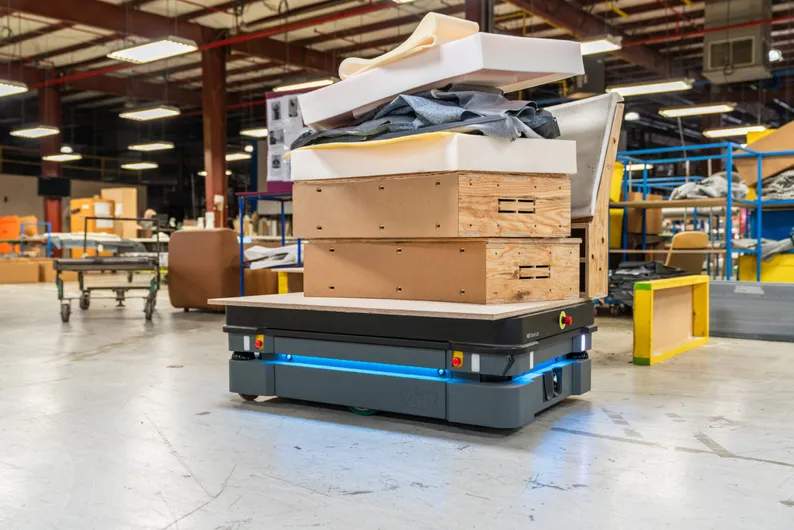
Jane Heffner: [00:00:37] So, MiR has just celebrated its 10-year anniversary. It’s been a very fast 10 years for us. A lot of installations around the world and a lot of new developments of developing the technology as we’ve worked through, you know, from that perspective. We now have over 9,000 robots installed around the world that are operating in many different facilities. And in some of those cases, many of our customers have significant numbers of robots in fleets that are operating rather than just exploring how does MiR work? How does an AMR work? So, people are really using them now for significant activities that are, that are going on. I’ve been with MiR now since February of last year. I joined after previously being in the robotics industry for six years. And I think what’s interesting and exciting for me is to see the interest that we are generating. I think people have, have looked at playing with them, if for want of a better word, for a long time, and now they really understand the value that they can bring, and now they’re really beginning to implement them into quite complicated applications. And we’re happy to help with that. So, yeah, seeing a lot of good, good activity and significant fleet development going forward.

Winn Hardin: [00:02:01] What kind of number represents one of the largest fleets that you’re aware of? I’m just curious.
Jane Heffner: [00:02:05] Probably about 400 robots with one customer, not all in one facility, but across the world.
Winn Hardin: [00:02:11] Gotcha.
Jimmy Carroll: [00:02:12] You know, you talk about the growth of MiR over the years, and I first met a colleague of yours maybe seven or eight years ago at Automate, and it was a it was a modest-sized booth, and at the next Automate, I went to the booth and it was massive. And I’m like, wow, this is, this is quite the development, right? In the past seven or eight years or over the course of the 10-year history of the company, what are some of the primary ways that the product itself has grown or developed in terms of visual capabilities or payload capabilities or speed or battery or anything like this? What are some of the most interesting ways that you’ve seen these robots progress?
Jane Heffner: [00:02:54] Yeah. So, I think a couple of things, you know, we were purchased by Teradyne, which has semiconductor test equipment background. So, obviously coming out of that marketplace, the emphasis on quality for that product is absolutely critical, right? And so I think one of the aspects that Teradyne has been able to bring to us has been the manufacturing discipline that we really needed to move from being a startup to really being a true company. So I think, you know, we currently have three different payloads that we’re selling into the marketplace. Teradyne has come in, and we’ve spent a lot of time driving quality into the products that we already have so that we really make sure that it’s quality first, and there is a quality product that is going out to the customer. I think our customers will tell you they’ve seen improvement with that. We have more work to do from that perspective. The quality journey is never done, but it’s definitely moving in that direction. Additionally, Teradyne also purchased a company called AutoGuide, and AutoGuide was merged in with MiR about a year ago. Actually, it’s probably about a year and a half ago now, and the goal there was to complement the low payload that we have right now with much heavier payload product. It was rebranded as MiR. AutoGuide disappeared last year. It was rebranded as MiR, and we’re in the process of bringing new products to the marketplace to satisfy the heavy payload requirements that are out there.
Winn Hardin: [00:04:31] What are the payload ranges we’re talking about?
Jane Heffner: [00:04:32] Today is 250 to 1350 and then this will take us up to, you know, much heavier, like pallet jacks and forklifts and forklift capabilities. So, much, much heavier payload from that perspective. What we want to make sure is, driving back to the quality again, is that we do it right. We will be able to operate off one software platform for all of our robots no matter whether it’s heavy payload or low payload. And stay tuned. I mean, hopefully those will be coming to market later this year. And, you know, we’ll be able to demonstrate some of that at Automate coming up this year.
Jimmy Carroll: [00:05:08] Very cool. Looking forward to seeing more about it. I can’t remember what network it’s on, but on one of the streaming networks that has one of the TV shows I’ve been bingeing lately, there’s a recurring commercial for Salesforce with Matthew McConaughey, right? And he says, if, if AI is the Wild West, is data the new gold? He says data. But data. Is data the new gold. What are what are some ways that.
Winn Hardin: [00:05:30] He’s always right, man.
Jimmy Carroll: [00:05:31] Yeah, I mean he’s far too handsome to to disagree with. Right. So, but what are some ways that you, that you can use data as a selling point to your customers to say, we’re going to give you this data so that you can improve operational efficiency? Do you have something like that first of all?
Jane Heffner: [00:05:49] So, at Automate last year we launched MiR Insights. And MiR Insights is built off of a fleet management system. And the capability that that brings us is that we use fleet management to help our customers manage fleets, right? So, we’re seeing, as I said earlier, we’re seeing customers now really adopt in much higher volumes. And the fleet management element of that, having all of those robots dance together, is basically very, very critical, how we do that. But while we’re doing that, we’re gathering data. And so what we’ve done is we’ve taken that information, and now we’re able to offer that back to our customers to basically help them optimize, you know, maybe mission layouts or productivity. See how they’re using them and then based on lessons learned and best practices that we see in other places, help them with, with their optimization and a continuous improvement process that we can move forward with. So, it’s very new. Many of our customers are just beginning to adopt that, and we’re beginning to take that to them. So, you know, hopefully the next time that we talk, we can talk about some really specific examples of where we’ve seen that optimization occur.
Jimmy Carroll: [00:07:02] Okay. Very cool.
Winn Hardin: [00:07:03] Is that a cloud-based program?
Jane Heffner: [00:07:04] It is. Yes. It’s a cloud-based program. And, yeah, it is.
Winn Hardin: [00:07:09] Are you able to sanitize? Are you able to use customer data in a sanitized environment so that you can actually make your product lines stronger? When we talk about, are you able to sanitize data, operational data, that then MiR can say, all right, let’s take all this data from different verticals and analyze it and make our product lines stronger. Or is it is that is it always us pushing software and technology out to the customer base, or are we going to start seeing . . .
Jane Heffner: [00:07:34] We’re in this pivotal position. We’re kind of like at this tipping point, right? We’ve very much been about pushing information out and pushing product out, and whether it’s software, whether it’s hardware. We’ve been pushing product out to the customers, right? I think now we’re in a position where we can start to use data that’s basically out there to help us with product development, to basically look at kind of how do we optimize, like what is the health checking of robots, how can we see what’s basically going on in your facility and then maybe, you know, come back to you and be able to say, okay, maybe some maintenance here or some help there would, you know, be helpful.
Winn Hardin: [00:08:13] Predictive maintenance. I would think customers would engage with that.
Jane Heffner: [00:08:17] Absolutely, yeah.
Jimmy Carroll: [00:08:18] One thing I wanted to ask about was growth in general, right? So, in the last couple of years, COVID and this persisting labor shortage have highlighted the increasing importance of automation. And, you know, that number is probably going to continue to go, to go up as people adopt automation more and more. But from your perspective, you kind of mentioned earlier that people have gone from maybe looking at this robot as something to play with, and they’re kind of unsure of how they’re going to use it. But now people are really using it and finding different ways to add value. I’m just curious. In addition to the obvious things like the labor shortage, what are some growth drivers behind that? In the warehouse and beyond?
Jane Heffner: [00:09:00] Yeah, I mean, I think, obviously, you talked about, the labor issues that we face, that’s going to be an ongoing issue for us continuing to move forward. And again, it’s not about replacing the people that are there. It’s about basically taking very simple functions. So, anywhere where you have somebody pushing a cart from point A to point B, that’s something that a robot can do and then we can upskill that person to be able to do much more rewarding positions that are basically out there as well. Some of the other drivers are the coming out of COVID, right? We’re seeing a lot of companies that still want to go to lights-out capability. You know the definition of lights out is a big word, right? It’s like, I think there still needs to be obviously some involvement from people from that perspective. But in the general concept of lights out, the robots, you know, they don’t call off sick.
Jane Heffner: [00:09:56] They continue to work. They don’t need to be on different shifts. You can have one robot that works 24 hours a day. And, we’re not going to face any labor issues or anything like that from that perspective. So, I think all of those aspects, not just the shortage, but, you know, just basically the productivity that you can bring from a robot is incredibly important. And just listening to some of the things through the conference, that’s not going to change. I mean, it’s, you know, I think our labor issues are very deeply rooted. And it’s going to go on for a long time. And it’s wherever we can look for simple applications to introduce people to how the AMRs work and so that they can get used to them and they can get familiar with them rather than super complicated projects. There’s a lot of very simple stuff that we can start with and work around to introduce people and get them more familiar.
Winn Hardin: [00:10:50] Get them familiar with a little bit of productivity gains and help them take the next step to the next step.
Jane Heffner: [00:10:54] Yeah.
Winn Hardin: [00:10:54] You know, I’m really wondering, since we’re each, we’re kind of at the beginning of a maturity acceptance curve, right, when it comes to AMRs. I wonder if, if we either have it now or do you have any gut feelings now or if you will in a short period of time, do you think that we’ll be able to go to warehouse companies and say, basically, these guys use autonomous mobile robots in their operations, their logistics, and it correlates with a better culture. So it’s not just about productivity gains, but there’s more career paths, there’s more ability to upskill, as you, as you mentioned earlier. I’m just wondering if we’re going to see a point where people would rather, you know, we hear from McKinsey and others, they’d rather work for companies that are leveraging technology rather than purely manual labor operations. And I wonder if someday we’ll actually see data to that point.
Jane Heffner: [00:11:41] Yeah, I think, you know, I’ve seen in the last year since I’ve been at MiR. I had a great time visiting many of our customers and our partners and seeing what’s out there. And what’s been interesting to me is that when I really feel that the culture has been accepted is when the robots are given names, right? So, the employees will actually name the robots, right? Like they’re a member of the team. And it’s, it’s a very different . . . In some cases, we’ve had some customers who’ve gone through a lot of challenges in the implementation. And it wasn’t necessarily an easy implementation. But they’re now past that. And now they fully, you know, everybody on the floor fully values the robot as part of that team’s ability to get their job done. And I think when you see that, when you see that happening, I think it takes a little bit of time for people to kind of get over their concerns and . . .
Winn Hardin: [00:12:34] Change is always tough.
Jane Heffner: [00:12:35] Yeah, change is always tough. But I think once they see how it helps them. Yeah. It’s been, it’s been pretty exciting to see. There’s some really creative names out there too. So it’s fun.
Winn Hardin: [00:12:46] Do you have a favorite that comes to mind?
Jane Heffner: [00:12:48] I don’t know if I can put this on the podcast, but we were at one place where they basically named them after Disney villains. Being here in Orlando, right? They named them after Disney villains. I think they probably named them that way initially because that’s how they felt about them. But now there’s an endearing element to it. So, you see Jafar running up and down the corridor. It’s kind of fun.
Winn Hardin: [00:13:08] Love it. Very cool.
Jane Heffner: [00:13:09] Very cool.
Winn Hardin: [00:13:10] Can I circle back real quick to, early on, you mentioned that one of the things that Teradyne was bringing to you was improved manufacturing, greater uptime, reliability. Is there a metric or anything that you normally share with clients or that talks about the improvements in that area?
Jane Heffner: [00:13:24] I don’t have the figure for you, but yes, we measure now basically productivity, uptime in our facilities, you know, out-of-the-box successes, right? How many robots we’re taking out of the box and we’re just basically implementing them and moving forward. Those are significant quality metrics. And I think when you work with a large global company like Teradyne, those kinds of metrics are what drive your manufacturing goals. And it’s, it’s a lot of measurements. It’s a lot of review. And I think those kind of KPIs are also drifting into other processes. So, it’s about putting processes in place, whether it’s a sales process, whether it’s a quality process, whether it’s manufacturing process, whether it’s a marketing process. What are those processes, and are they being effective, and how do we measure them through KPIs? And I think that’s something really important that Teradyne can bring to us. You know, they’ve got a global reach. They’ve got this manufacturing discipline that they can bring to us as well. They’ve worked with very big customers for many, many, many years. And so they bring that larger customer strategic account management concept as well. And they work in the technical environment as well. So, we’ve now formed what we call Teradyne Robotics. So, UR and MiR both roll up under Teradyne Robotics, which is a separate entity. And yeah stay tuned, and maybe that area is going to grow.
Winn Hardin: [00:14:55] Plus global engineering support I’m going to assume.
Jane Heffner: [00:14:58] Absolutely. Engineering, you know we’re working through like how we work that. Slightly different in the technology but, yes, absolutely. We’re able to to leverage a lot of years of experience from Teradyne into the field.
Jimmy Carroll: [00:15:13] Jane, what else haven’t we asked about today that you know, you’re excited about at the company or in the space in general?
Jane Heffner: [00:15:19] Yeah, I think, you know, I think what’s exciting to me for MiR is that, as I said, we just celebrated our 10-year anniversary, right? Which isn’t very long, right, in comparison. But in the AMR world, it’s a significant length of time.
Winn Hardin: [00:15:34] I would have guessed longer, to tell you the truth.
Jimmy Carroll: [00:15:35] Yeah, same.
Winn Hardin: [00:15:36] It’s probably just because I’m old.
Jane Heffner: [00:15:38] Well, and I think, I think where we are now is, you know, people know our name. I think we’re building trust with our customers, and I think that what MiR can bring is 10 years of experience. We’ve skinned our knees, right? Whenever you introduce new technology, there’s going to be challenges associated with it. And we’ve learned a lot during that period of time. And so I think what we can bring to customers is that experience and a faster ability to scale up and to get them where they need to be so that they can really realize the, the benefits, you know, of, whether it’s automation in general or working with AMRs.
Winn Hardin: [00:16:22] I’ve got one last question, if we could. You mentioned you are, being part of Teradyne family, are we software compatible? Are we ready to put arms on pedestals?
Jane Heffner: [00:16:32] Well, we have an arm on a pedestal right now through a third party, and we’ve worked that through a third party at this point in time. We’re beginning to roll that out to the marketplace, to certain different spaces to, to kind of see what that compatibility and see what that interest looks like.
Winn Hardin: [00:16:50] Gotcha.
Jane Heffner: [00:16:51] And I’m sure that there will be more development around that. There’s a couple of beta test units that are around the country. And we had one yet last year at Automate as well. Gained a lot of interest from that too. And I think that will continue to really gel and grow as we move forward.
Winn Hardin: [00:17:08] Cool.
Jimmy Carroll: [00:17:09] Well, it sounds like there’s a lot of exciting developments on the horizon, and everyone should keep an eye out. Jane, if people want to learn more, what’s the website?
Jane Heffner: [00:17:17] It is MirRobots.com
Jimmy Carroll: [00:17:19] MiR Robots. And of course, on LinkedIn. So, Jane, it’s been a pleasure talking to you. I really appreciate your time.